Blog

Category Archives: Latest writing

Wallis Simpson in Shanghai…again

Advice to Pedestrians in Shanghai

A shorter version of this diary appeared in The Telegraph March 15th 2012

Researching my biography of Wallis Simpson in Shanghai a few years ago I had a hunch. Now I am here again trying to take that hunch one stage further even though my book has been published. In 2010, I believed I had discovered the name of a man Wallis coyly described in her 1956 memoir, The Heart has its Reasons, merely as ‘Robbie.’  She said she could not give his full name but he sent her baskets of exotic fruit and dancing with him underneath a bower of flowers made her feel she was in Shangri La. Life was so good, it was “almost too good for a woman.”  Why could she not identify him?  And why was continuing the friendship with him in 1924-25 ‘purposeless?’ He was not married so it was not a question of destroying a marriage. Yet, as he had a male business partner the possibility that he was gay, unmentionable in the 1920’s, cannot be discounted.

I guessed – but could not know – that Robbie was quite probably the architect of the clubhouse for the 66-acre Shanghai racecourse.  This clubhouse, the epicentre of smart expatriate life, was rebuilt in the 1930’s by one H.G. F. Robinson, according to the foundation stone. Sure enough, the London archives of RIBA confirmed that a British architect by this name had gone out to Shanghai in the early part of the last century where he founded a successful partnership, Spence, Robinson and Partners.

But it was only a guess – until my book was published. Then, after giving a talk at Cheltenham Literary Festival last autumn, I was approached by an elderly lady queuing patiently to buy my book. “I hope you’ve mentioned my Uncle Harold Robinson,” she said as my pen was poised to sign. It was an extraordinary moment not only because she thereby confirmed what I had surmised but then proceeded to tell me much more. We have been corresponding ever since and she has filled in some gaps, sent me photos of her uncle and told me other stories. “Uncle Harold would never hear a word against Wallis,” explained my informant, now almost 90, whose own family lived in Shanghai’s International Settlement. “He thought she was wonderful.” Uncle Harold introduced Wallis to a highly sought after doctor in Shanghai society, Dr Hugo Rudolf Friedlander, known as Freddy. “Dr Friedlander became much involved with Wallis and ‘her problem’ and recommended a surgeon for her.” What problem? Ah well, my mother had ideas on that, added my informant tantalisingly.

So, on this visit I am trying to discover more about Dr Friedlander and, after a morning poring through various Shanghai directories, including an impressive tome called Men of Shanghai and North China, I find him.

In 1923-4, Dr H. R. Friedlander MRCS LRCP lived at 396, Avenue Foch and practised at 3 Peking Road.  His consulting hours were advertised as 11.30 am – 1 pm. What, I wondered, did he do the rest of the day?  My Cheltenham source revealed that Dr Friedlander left Shanghai in a hurry in 1929 following a scandal involving her aunt, a British woman who left her husband and three sons for him. The new family moved swiftly to Kent, although Friedlander himself died in 1960  in Auckland, which is where my research will take me next. Watch this space.

*****

I am giving talks about Wallis at both the Beijing and Shanghai Literary Festivals, the latter a firm fixture on the Shanghai cultural map for the past decade, the former still a tender sapling. Wallis, jealous to a fault, especially when younger women such as Marilyn Monroe pushed her off the front page, would be thrilled at the current interest in her story. Both festivals are the brainchild of Michelle Garnaut, a creative Australian restaurateur and generous philanthropist who set up a restaurant called M on the Bund in one of the grand old buildings on Shanghai’s main street just as the economic boom was taking off.  The sister restaurant, Capital M, in Beijing overlooks Tiananmen Square. Both locations bear her hallmark quirky, colourful style and writers are pampered throughout their stay, culminating with a fabulous author dinner on Sunday night before returning, Cindarella-like, to our lonely writing lives. She attracts dozens of sponsors – thank you Virgin for flying me there and back – without whom these festivals could not exist. Authors could do with more Michelles around the world enthusiastically promoting their books.

*****

In Shanghai my session on Wallis Simpson was introduced by the British Consul-General, Brian Davidson, now on his third posting in China after a brief spell in Lithuania in between. We compared notes over lunch about the difficulties of giving the same talks for the twentieth time and making each one sound as if it were the first. He addresses Chinese industrialists, persuading them to invest in Britain. I think I have an easier task. Sebastian Wood, the British Ambassador, said over dinner two nights before that armed guards permanently stationed at the gate of his residence were a constant reminder to him of quite how different this country was. In case we had not already noticed, the mistranslations we saw everywhere did the job. At the passport inspection barrier we were encouraged to ‘raise our children up’, on the airline we were offered a ‘distinct wet tissue’, in the car park we were warned to ‘note relaxin vehicles,’ whatever they may be.

*****

The main story while in Beijing may have been the annual  National People’s Congress, but I was more interested in a story in the China Daily Post headed ‘Flushed with Success’ about a protest demonstration by women in several parts of China agitating for more female lavatory stalls. After all, everyone knows that women take longer than men and there are always queues outside women’s toilets, rarely at men’s.  Who said this was a different country? Women of Britain take note!

Anne Sebba is the author of That Woman, a Life of Wallis Simpson Duchess of Windsor (Phoenix £7.99)

Visiting Germany in 2012

Daniel Liebeskind/ Felix Nussbaum house in Osnabruck

Travelling to Germany to give lectures this week, I go first to the pretty medieval town of Osnabrück. My kind hosts show me the sights, starting with the historic town hall of this so called City of Peace where in 1648 a treaty was signed ending the thirty years war. Ah, if only that had been that… The town hall,  with its impressive oil portraits of the signatories and 12th century chandeliers, is a good place to sit and ponder. Osnabrück is also the city where, as recently as 2009, the British had a garrison, the biggest in Europe outside the UK. It is partly the reason for my being invited to give a talk as British army wives decades ago decided that a good way both to cement relations between victor and vanquished and one which would give themselves a reminder of British culture was to form a group called British Decorative and Fine Arts Societies, an offshoot of the better known National Decorative and Fine Arts Societies – or Nadfas.
Just across from the old town hall, in a cobbled square that no doubt comes alive with Christmas markets, I visit the Erich Maria Remarque house. I’d always wondered about that name and what else he had written. In fact he was born in Osnabrück in 1898 as Erich Remark but later took Maria in memory of his mother and changed the K to the more interesting ‘que’ when he became famous. He was extremely handsome and the museum tells the story of Remarque’s complicated private life as well as his work – his friendship with Marlene Dietrich and marriage to Paulette Goddard – and how he fell foul of the Nazis for his damning indictment of war. When they could not reach him they killed his sister instead. After World War 2, he lived in Switzerland, worked on screen plays and many other novels, some of them bestsellers but never quite repeating the success of his early work. All Quiet on the Western Front, which examined the experience of ordinary soldiers, was rejected by numerous publishers until Ullstein took it on. Seeing the much scribbled on hand written manuscript was a reminder of the many different perspectives have created this powerful country.
“Ah yes that happened in former times,” I kept hearing, or “Those were dark days.“ Many ordinary Germans lost homes, possessions, parents and loved ones and it is true that few of the older generation in Germany have not suffered.
But the strongest and most painful reminder of quite how dark those days were came from a visit to the Daniel Liebeskind museum dedicated to that other son of Osnabruck, Felix Nussbaum. Nussbaum, born in 1904 into a prosperous and cultured family, died at Auschwitz  aged 39 in 1944. The Nussbaum Haus is dedicated to his memory and is extraordinary not least for the vast number of Nussbaum paintings that have survived and come back here, including many self- portraits. The building itself , the first Liebeskind building to be finished, shows how the architecture contributes to the experience as it is full of oblique angled walls, sloping windows and angular niches giving a strong sense of lost orientation and withering hope. The growing coldness of the materials – zinc and cement – add to the sense of impending doom for Nussbaum and yet his most powerfully assertive work was arguably created when, after hiding for months in Belgium, he knew he would not survive yet continued painting. Facing the certainty of death he created The Triumph of Death in which he tried to assert that, even when the world is in ruins, a dance of death goes on. He wanted it to be seen as an artistic response and act of liberation and self -assertion amid all the barbarity.

Image taken from WikipediaThe Felix Nussbaum Haus in Osnabrück, Germany. A museum, designed by architect Daniel Libeskind, which houses around 160 paintings by the German-Jewish painter, Felix Nussbaum, who was killed in the Holocaust.”

New discoveries… after publication

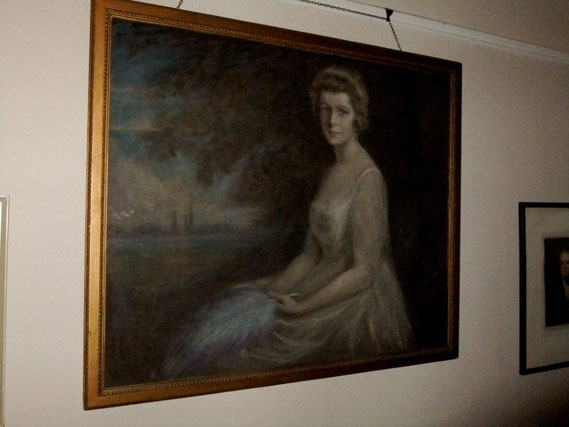
Mary Kirk Raffray picture in Edinburgh

It’s impossible to predict exactly what will emerge on publication of a biography but, rest assured, someone will tell you something you wish you had known before.

So, the letter that arrived telling me of the existence of a beautiful portrait of one of the key characters in my biography of Wallis Simpson, Mary Kirk, was both a thrill and not exactly a surprise. This week I travelled up to Edinburgh to see it.  It is a large (3.5 X 4 ft) pastel,  apparently commissioned by her soon-to-be husband,  the dashing Frenchman Jacques Raffray and, according to family lore, painted from photographs. It was intended as an engagement present for Mary and Jacques but never sent to America. The artist was Raffray’s aunt  ‘Minnie’ Rutherfoord – (Minnie’s sister had married Jacques father)-  a professional with a number of works accepted for the Royal Scottish academy exhibitions between 1895-1920. This was to be the last one she showed there in 1920 and bore the rather curious title ‘Down in the Forest’ curious because the background is more of a lake than a forest.

I had always known Mary Kirk was beautiful but the only pictures I  could find for my book showed her in her middle years.  Still attractive but rather matronly, the inevitable (and fashionable)  cigarette dangling from her fingers. This portrait would have been much more striking and perhaps better explained her story. She was a childhood friend of Wallis but travelled in Wallis’s slipstream and manipulated by her. Eventually, when Wallis was looking for someone to occupy husband Ernest while she was off on holiday with the King,  Mary and Ernest fell in love. It’s not hard to see why.

The picture, approaching its own centenary, is in good condition although a little faded. Moving or cleaning it might destroy it. The present owners , relatives of the artist, have always known something of the sitter’s history but  it was seeing Mary Kirk in C4’s The Secret Letters, the recent documentary based on my book,  that stirred them to contact me in the hope of discovering other Kirk relatives .

I have puzzled over why this beautiful portrait  was never sent to Baltimore. Perhaps its size or delicacy made that difficult but surely not impossible. Or was it because the marriage between Mary and Jacques soured more quickly than I realised?  I doubt this because Mary always wrote in affectionate terms of Jacques, even as she contemplated divorcing him. But who knows? I am certain that,  had Mary known of the portrait’s existence once she married  Ernest in 1937 and was living in London and especially after a warehouse fire destroyed many of their most precious possessions,  she would have wanted it in their house in Upper Phillimore Gardens. Mary  died of cancer in 1941 leaving a two year old son who later changed his name and moved abroad.  He too never knew anything about the portrait,  which has now acquired a life and a story of its own.

Images of Wallis

One of the most frustrating aspects of publishing a book , finally, after years of research is how so many people contact you with anecdotes or information that it’s too late to include. If only they had ‘reached out’ to you sooner. Of course there’s always the paperback!

But occasionally you hear from others toiling in the same muddy ditches and – very occasionally this – there is even scope to combine. Such was my luck this week when I heard from Jessica Palmer, a cut out artist. Jess is a former TV producer who gave it all up to do an MA in Illustration and now specialises in cut-paper and collaged images. Her work features on book covers and in galleries. She is a visiting artist at the V&A, Dulwich Picture Gallery and other museums.

She produces amazing pictures of a wide range of characters but something about Wallis Simpson piqued her interest a little after I had started work on my work. Look at this and you can see why.

The final chapter of my biography on Wallis Simpson, That Woman looks at the reception of Wallis after her death and how plays films books and paintings have changed perceptions

Cecil Beaton, in spite of some less than kind comments in private, turned her into a beauty.  Jack Levine was satirically cruel now Jess Palmer. Watch for Madonna’s glamourous version due out later this week.

London’s Bestsellers

That Woman by Anne Sebba named as a Dark Horse in the London Evening Standard’s Bestsellers list.

‘Wallis Simpson vindicated’ is the tagline. Fantastic!  Not sure who’s the Dark horse, Wallis or me?   But someone has understood that, however hard she is to like,  understanding Wallis is half the battle. Of course she’s flawed but oh, how much more interesting for being complex.