Blog

Category Archives: Latest writing

What I really mean when I say I am going to Paris for a few days…

Why does nobody believe me when I say I am going to Paris to work? No, not shopping, I pronounce confidently, it’s a research trip.

‘Ha, ha! Have a nice holiday,’ they say as they wave me off. If I told people I was going to Berlin or Edinburgh, or even Geneva, they wouldn’t make the same automatic assumption.

Is it because of the latest shenanigans with President Hollande and his motorcycle helmet that people assume Paris is code for doing something else? Or is it historic, this attitude to Paris? Certainly a German soldier posted to Paris in 1941 rejoiced. Of course it was better than the eastern front. It had food, women, perfume and brothels.

A tiny part of me, of course, doesn’t mind the teasing. It’s why I am writing the book I am about women in Paris in the 40’s, both during the war and after it. I knew instinctively when I proposed the idea that what de Gaulle managed to do after the war for the whole of France was writ large in Paris. He ensured that the idea of Paris, the notion of a city, depended upon its reputation as a hub of beauty, gastronomy and fashion – and he succeeded magnificently. Paris is exciting. It is a breathtakingly beautiful city whose buildings, if not its honour, remained virtually intact after the war. The brothels may have been closed down (more or less…at any rate they were made illegal in 1946) but, seventy years after the liberation, Paris is still the city of romance par excellence. Parisian women look stunningly fashionable, just as they tried to do throughout the War.

Well, mostly they do.  The everyday reality is different for anyone who travels beyond the centre to the suburbs. Try telling anyone who spends days in the subterranean enclosure that is the Bibliotheque Nationale or the National Archives, which are located miles outside the centre in a desolate part of the city,  that you are going for a romantic holiday. The train from the airport to the centre – for those who do not use Eurostar – comes past a number of dreary suburbs including the hellish Drancy. How could anyone live in a town whose name is a byword for the evil perpetrated on French soil?  The metro is often crowded full of thousands of jostling, unfashionable, ordinary women going about their daily business as well as beggars and thieves just as in every European city. Tragically people throw themselves under trains here just as they do in London. I have noticed however that French seem not to treat the metro as a convenient place to have a smelly curry in the way do in London.

Fabulous shops in Paris, boutiques

So what about the shopping?  Well, there are some fabulous shops in Paris, boutiques which are not part of any chain selling wildly original objects displayed eye catchingly. There is a sweet smelling artisan chocolatier or patisserie on every street corner and an ‘artisan’ bag or belt maker on several others. Haute cuisine and haute couture are put within the tempting reach of every miserable passer-by. Right next door to my hotel is a fabulous designer hat shop but so far the prices have kept me just a window shopper. I just look longingly at the beautiful designer shops and popup shops and the unusual –objects- which-I-really- don’t-need-shops. I even found myself stopping outside a designer spectacle shop today and feeling deeply covetous. So far, other than the occasional gift, I have kept away.
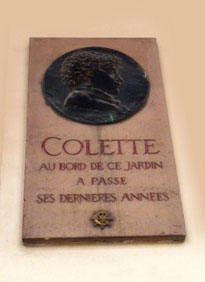
ColetteBut yesterday my resolve cracked as my research took me to a new part of town – the Comedie Francaise archives are located not only right in the centre of town but in the Palais Royale, nestling among the historic arcades full of designer boutiques. The writer Colette lived here and ever watchful had a good view of several unsavoury comings and goings during the War. My hands were dangerously cold, I decided. I had to have some gloves, some Parisian gloves I convinced myself. And as my cosseted fingers recovered their feeling I recognised that these fabulously expensive gloves are just softer, sleeker, longer more supple than any gloves I have ever bought in London. No I am not acquiring a Parisian shopping habit. They are only gloves after all.
The Pram in the Hall – Enid Bagnold Writer and Mother

gaudier-brzeskaA talk I gave recently at the October Gallery – The annual Persephone Lecture

I have never thought it a particular advantage to know the person you are writing about. You will have known them at a particular time or in a particular role. Above all, for a child to write about a parent seems to me a recipe for disaster – unless you state from the outset this is a very one sided memoir. Children are often the least useful witnesses a biographer can find. Yet, try as we might to be objective, I think biographers too should plead guilty to subjectivity, to seeing their subject through a particular prism. Perhaps they lived in the same village, studied at the same college but in particular I believe that what we really cannot shed is the age we are at time of writing. However much I think I can imagine a particular emotion, or I am sure that I know what a particular experience must have felt like, I want to take this opportunity – openly and unequivocally – to admit my failure. Only now, having hit 60 myself and living through an age-obsessed time when the secret of eternal youth is promised from many quarters, do I really understand what Enid Bagnold – not exactly a vain woman but one who cared about her looks – meant when she wrote that one of the few counterbalancing factors for the pain of growing old was that, thanks to fading eyesight, she couldn’t really see all those wrinkles and grey hairs that worried her so much in anticipation – (although true to her novelist’s calling, exaggerating to make her point – she is not being wholly truthful even here as of course magnifying mirrors were around in the 1980’s.) But I can now at least understand why she wanted to have a face lift (and how radical was that in the 1970’s) and I admire her honesty and truthfulness about discussing this far more today than I could possibly have 30 years ago.

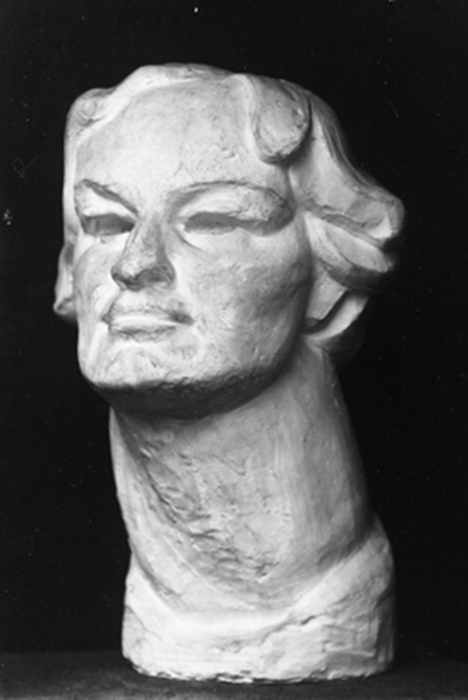
And here she is as Gaudier Brzeska saw her on the eve of WW One

So, I am immensely grateful to Persephone for giving me this second chance to look at Bagnold thirty years on. And of course to Faber Finds for republishing my biography. I’m relieved to say I haven’t found a different person or a different story. But the focus, if I were writing the book today, might be slightly sharper here or hazier there. The emphasis on different aspects of her life might be weightier here and pruned there. Actually I don’t think it would be a better book (I would say that wouldn’t I?) But I now understand in a wholly empathetic way why, in her 60’s and 70’s, she was still burning with ambition to write a successful play. I remember, with shame, a feeling in my 20’s that when I reached 60 I’d be happy to stay at home quietly knitting whereas in fact my desire to travel, to meet people, to achieve and to experience life is not only unabated it is in some ways greater as I am acutely aware of the limited time left and…and I can see why it risks appearing frankly unbecoming in someone of my years just as it did for Enid.

No, I think, or at least hope, that writing the biography of EB in my late 20’s gave me a youthful enthusiasm which suited my subject and gave me a perspective on her young days and early married life I might not have had now. I was rooting for her when the boyfriend didn’t work out (after all it wasn#39;t so far away for me that I could still remember those rejections, sharp longings and early fumblings) but most of all I deeply identified…and I say this fully aware of strictures by that great biographer Richard Holmes that self-identity with one’s subject is the first crime of a biographer…with her passionate desire to have babies and having had them to have more of them and then to be the best mother there had ever been. I understood the passionate and oh so unexpected flood of love when her first golden-haired child arrived – love neither she, nor I, knew we possessed. And then she found it a second time for her equally beautiful son – just as I was to do. My pigeon pair as I learned. The Squire, her truly great novel not just about motherhood but about what she believed it meant to be a woman, springs from that deep well of unconditional love. Enid wanted to go on and on, bringing up such treasures.

The Clifford Sisters for Femail Writer Enid Bagnold picturedSo let’s go back a bit. Who was Enid Bagnold? In her own sparkling and idiosyncratic autobiography (entitled I am tempted to say with no artifice but of course there was artifice aplenty) ‘Enid Bagnold’s autobiography’, published in 1969, she writes that she was driven to explore family history because of her fascination that “sperm had been shot across two centuries to arrive at me”. Such an earthy – and original – simile was typical of her writing (she once described her own prose as ‘beautiful vomit’) but what she is also revealing is an intense fascination with herself. Not unusual for ‘a born writer!’ as she called herself. When I came to research her biography I found all her notebooks and scrapbooks were embellished with directions/ guidance for a putative biographer – me! Pictures of the Franco-Romanian princes, Antoine and Emmanuel Bibesco, for example, princes who had been close friends of Proust, were annotated with helpful comments like ‘this is the brother who committed suicide’ or ‘here we are visiting a church together’!
But Antoine Bibesco, the man she always adored, was never going to marry the plump and rather jolly Miss Enid Bagnold, daughter of Colonel Arthur Bagnold, a man who was as much engineer as soldier, and the former Miss Ethel Alger. They were, as her parents regularly reminded her, gentlefolk, and had been for generations. Enid was constantly testing her parents either by her requests to paint nude models when she studied with Sickert (turned down) or her request to visit the old roué journalist Frank Harris, her editor as well as lover, when he was in Brixton prison – agreed to “because people of breeding do not abandon a friend in need,” her father told her. Read More

What Brighton means to me

One of the most powerful images from the Vienna Portraits exhibition currently at the National Gallery is by Egon Schiele of himself and his pregnant wife dying of Spanish ‘flu. He was to succumb to it himself three days later, aged just 28, later described by the Nazis as a ‘degenerate’ artist. I cannot empty my mind of this picture and the thought of all that lost brilliance. Yet in an exhibition where death is continually hovering and suicide ever present,  it’s impossible to know how would he have dealt with all that was to follow after 1918?

Between 50 and 100 million people across the world died of what became known as Spanish ‘flu.  One of the most shocking aspects was the way it could sometimes claim its victims in a day and was especially virulent among the previously healthy young.  After waking up with a shivery twinge, victims might find by lunchtime that their skin had changed colour to a vivid purple and a few hours later they were dead, sometimes choking on thick scarlet jelly that suddenly clogged the lungs. The pandemic has been described as “the greatest medical holocaust in history” and may have killed more people than the Black Death killed in a century.

I have often thought of this pandemic as my own aunt, my father’s older sister, Irene, died aged 12 in 1918. My father’s family had moved to Brighton hoping this would be safer than London because of the new terror of Germany’s doodlebugs. But Brighton, being a port, was in fact more dangerous as the disease was thought to have been carried ashore by travellers. My grandfather, a Lithuanian Jewish immigrant who had been in England less than 20 years, never recovered from the loss of a favourite daughter and gave up on joy and God.  They were buried with my aunt in a Brighton cemetery.

Brighton can never for me be simply a seaside resort.  I have always known that my father was deeply scarred from the loss of the sister he barely knew when he was six and the consequent suffering endured by his family for whom emotions must have been ‘unexploded’ and so I relished a book which looked at the town twenty years later during World War Two.  Alison MacLeod’s  Unexploded is partly about attitudes to Jews and immigrants in Britain at the end of the thirties but it is also a deeply felt examination of repressed emotions waiting to explode as of course they do in the course of the novel. The background history is fascinating, never intrusive, but there is plenty to learn here about politics and history of art. For example Picasso’s Guernica is on show at the Whitechapel Gallery from December 1938 to mid-January 1939, the hero, Otto,  is a ‘degenerate’ artist and Virginia Woolf, whose suicide frames the book, enters to give sparsely attended lectures. I shan’t tell the story but it’s a powerful, often painful, read and Evelyn and her defective husband Geoffrey are utterly believable protagonists.

One other book I have read this week is Robert Harris’s brilliant thriller,  An Officer and a Spy. In this retelling of the Dreyfus affair virulent anti-Semitism in France is overt, barely repressed and with consequences which have shuddered down the ages. Even those of us who thought we knew this tale cannot fail to see it through fresh eyes.


Hidden panels, dusty books, silence at all times? That’s not today’s library.


A romantic library

Stacks of Books Here

When John Bayley proposed to Iris Murdoch she suggested going somewhere romantic to discuss the idea…the London Library!

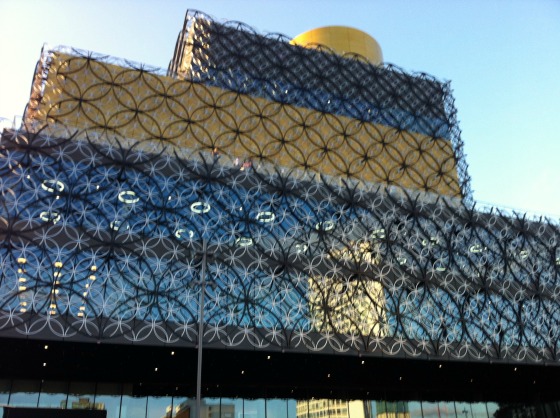
Last week, on the day it was opened, I climbed the neon escalator of the world’s newest library – the £189m Library of Birmingham, which over nine floors houses a collection of one million books, more than 200 public access computers, theatres, an exhibition gallery and music rooms! This is exciting at a time when public libraries are hit by the double whammy of government cuts and increasing use of the internet.

Birmingham library was formally opened by Malala Yousafzai, the teenager shot in the head in Pakistan by the Taliban for championing women’s rights. Malala spoke about how books were weapons to beat terrorism and how she believed that the only way to global peace was through reading, knowledge and education.

Where has this extraordinary young girl learned such composure and confidence? Through books, she insists. Some books travel with you back centuries, others take you into the future, some take you to the core of your heart and others take you into the universe, she said.

Looking at the fabulous collection here in Birmingham – its most valuable books are copies of Shakespeare’s First Folio and John James Audubon’s Birds of America – worth between £6m and £7m each- we can only hope there are more like her.  But it isn’t these books that will change the world, beautiful though they are. It’s ordinary stories, novels, biographies, philosophies and histories.  And the serendipity of finding something in a library is especially fun; who else has had pleasure in this book and what did they make of it?

The new Birmingham library is a stunning piece of architecture with roof gardens overlooking the heart of Birmingham and a wild flower meadow.  I am sure Iris Murdoch would have found it an intensely romantic place. Libraries aren’t just worthy places of silence any more they are vibrant, buzzy, humming exciting places to be. I’m glad that my own grandfather came to Birmingham from Krakow so that when I finally get around to writing his extraordinary story I shall have an excuse to research there. For the moment I shall continue to admire the steel girders eventually supporting my own personal library (well a study or an office, in truth) but it will house quite a lot of books that are very special to me so I am happy to call it, rather grandly – a library.  Really a library is just a nice place to be. Let’s have more of them.


Going Native

I have just watched (again) the incomparable Judi Dench star in The Best Exotic Marigold Hotel. I love the film but after my daughter kept telling me I reminded her of Evelyn, the Judi Dench character, not in looks but in my behaviour, I thought I’d better see why.

Evelyn embraces the new culture of India because she wants not simply to exist but to thrive there. She wears Indian clothes, loves Indian food and finds a job at a local call centre. She falls in love with India. And all I’m doing is merely trying to learn how to speak Greek. I don’t wear Greek clothes nor do Greek dancing. Although I do love Greek food. The trouble is I’m still, after two years of lessons, at the deeply embarrassing stage where I keep making completely inappropriate remarks. I asked the butcher  – apparently – for a live chicken as he told me when he answered me in flawless English and then asked if I wanted it whole or jointed. When passing an old boy with a donkey in the mountains I asked him what his name was and how old he was (I meant the donkey, obviously).

It’s not just that I am trying to learn the language as a good way to stave of Alzheimer’s, though that would be nice since God knows, the memory isn’t what it was when I learnt amo, amas, amat. It’s because when you learn a language you can communicate, you can understand the culture… I shan’t be reading Zorba the Greek in the original quite yet but I do know now that it is incredibly impolite to phone people between 2 – 5pm, which is why there are two words in Greek for afternoon; the early afternoon and the later afternoon and you can phone only during the later one.

A recent poll of 2,000 people by the British Council found that most British adults struggle with their inability to speak a foreign language when abroad, causing them embarrassment on holiday, even in Spain… and Spanish is a lot easier for Brits than Greek, where the word for ‘yes’ is the counter intuitive ‘nai.’ (But then in India, too, people shake their heads confusingly to mean yes.)

According to the editor of Wanderlust magazine, holidaymakers from the UK tend to assume that everyone will be able to understand them. “We’re nervous about doing it and not doing it right”, she explained. It’s an attitude bred from imperiousness as much as nervousness and nowadays, when so many people in the EU are fluent in many languages, it’s usually true. Brits struggling to speak a language badly will be answered in English so it’s tempting to give up.

Today, after 6 weeks of fairly intensive lessons, I had my test: I had to go to the market, under the eagle eye of my teacher,  and do all the shopping in Greek. No sign language allowed. When I wanted something bigger, I had to find the words, no touching allowed when I wanted to check if the avocados were ripe or too hard. Incidentally, that is one of the easier words in Greek (skleros means hard as in the way my arteries are going from all this intense brain activity). I know the words for aubergine, courgette, tomatoes and grapes. But I also need to remember the plural form and make them agree with adjectives … I managed to say ‘please’ and ‘thank you’ and ‘my grandchildren like broccoli’ and ‘how much is this?’

Sounds easy, uhh? You try it. Seriously go on, more of you should. I came home today with some lovely looking produce, not all of it quite what I had in mind but I’m sure it will get eaten. And lots of people had a good laugh!