Blog

Category Archives: Latest writing

Strangers you meet on holiday …

Seven years ago, wandering along a sunny Cretan beach, I was approached by a striking duo; the mother, an elegant American with curly, white blonde hair and her sophisticated daughter, a tall and poised twelve year old with a mane of equally curly, brown hair.  This was their first holiday since the woman’s husband and father of the girl, had died suddenly the previous year and they were looking for friends. What could be more natural and appealing, especially since we had a daughter roughly the same age? We struck up a conversation and a friendship.

Today the mother, Sheila von Weise Mack, is dead, battered and bruised to death, her half naked body dumped into a suitcase. Heather, her daughter, now 19, and her 21 year-old boyfriend, Tommy Schaefer, have been arrested in conjunction with the murder but not charged. The threesome had been on holiday in a luxury hotel in Bali, Indonesia.

Ever since I heard the tragic news I have thought of little else. Our two families had dinner together that night and, I rather imagined, that would be that – a holiday friendship lasting as long as the holiday, especially since the two girls had little in common. But, as soon as Sheila heard I was a writer, she craved deep discussions about literature, especially Saul Bellow, her particular passion. He was one of her teachers while she was researching for a PhD at the University of Chicago and obviously had had a huge influence on her. When she heard I was coming to the US that Autumn to promote my forthcoming book on Winston Churchill’s American mother, Jennie Jerome, she immediately invited me to stay at her luxurious home in Oak Park (a house stuffed full of memorabilia from her late husband, US composer and arranger, James Mack) and insisted on organising launch parties and book groups for me to address in Chicago. She was as good as her word and generously produced one of the most lavish launch parties I have ever been given. Some of the friends she introduced me to that night are still my friends and it was from one of them that I first heard of Sheila’s untimely and shocking death.

After that launch, we kept in touch occasionally with Sheila trying to arrange further meetings in London or Chicago.  Christmas cards were never a simple greetings card but a package of photos and news about Heather, a stunning girl and talented ballerina who, it seemed to me, Sheila idolised and devoted her life to. Whenever I was in the US she begged me to stay. She wanted to give me a literary guided tour of Chicago to show me the Ernest Hemingway and Frank Lloyd Wright homes. When I was researching Wallis Simpson, my next book, she offered to help with research into the family of Wallis’s first husband, Win Spencer who came from Highland Park in Chicago, another wealthy suburb.

But something held me back which I could not identify at the time. Much as I liked her, I sensed a deeply troubled and needy individual but, until yesterday, I could never have guessed quite how troubled.


Rhodes – a lost culture

Greek Island - RhodesI have just spent a few days on the idyllic Greek island of Rhodes. We ate well, enjoyed the tourist shops and explored some fascinating ancient and medieval sites. But the heart of the visit was the short time we spent inside the oldest Synagogue in Greece, now the only one remaining on Rhodes. The day we are there, July 22nd, it is – unusually – bursting with vibrant international life.

Seventy years ago, it was a different story.

In 1943 Rhodes, formerly ruled by the Italians, was taken over by the Germans. On July 23rd of the following year, even as the tide of World War 2 was turning against the Nazis, 1,673 members of the Jewish community were rounded up and shipped off on a long and arduous journey to Auschwitz, where most of them were killed on arrival. Forty two Jews who were able to claim Turkish nationality were saved from deportation, thanks to the actions of the Turkish Consul General, Selattin Ulkumen, and one hundred and fifty one survived Auschwitz. Today there are just a handful of Jews living on the island but, for the 70th anniversary commemoration of the deportation, descendants of those who once contributed so much to the island culture and history have reassembled from Canada, South America, the USA, Africa and Europe and we, with no connections to Rhodes beyond friends whose family was once a pillar of the community, find ourselves among them in the boiling sunshine as they search for homes where their grandparents or great grandparents once lived and flourished.

Greek Island - RhodesFor the Jewish community of Rhodes has a rich history dating back to the second century and, at its height in the 1930’s, had a population of almost 4,000 people and six synagogues. Many were Sephardic Jews who fled Spain at the time of the Inquisition in the late 15th century and spoke to Ladino, a particular variant on Spanish and a language now in danger of dying out. Although there were periods when they were not welcome, generally Jews on the island lived in harmony with their rulers. It is good to be reminded not only of this rich heritage but the important contribution Jews made to the island culture.

Why Books Matter in Prison

On Thursday my day started with a parcel, both unexpected and unordered, delivered by my cheery postman. ‘Young Titan,  the Making of Winston Churchill’  by Michael Shelden had been sent to me by a fellow Churchill obsessive, a man who knew that, tantalisingly, I had never been able to prove the existence of a serpent tattoo on the arm of Winston’s mother, the dashing Jennie Jerome, when I wrote my biography of her some years ago. This book, he believed, contained that elusive proof.  Well, it almost did. Perhaps proof in the form of an image will never see the light of day but I’m now convinced about the inky serpent on her wrist.

How lucky I am to have spent a few hours imagining this other world of racy Edwardian England visiting a high class tattoo parlour in Jermyn Street. Later the same day I voluntarily took myself off to prison for a night. Okay, I was fed and watered, took in my own sleeping bag and change of clothes and had congenial company in the other cells from 5 other publishers and agents. But even so, when the lights went out they went out. And in those moments before sleep it was just possible to imagine ‘what if’… What if that happened day after day, night after night, if the door was well and truly locked and there I was, left in a stifling airless cell with no hope of waking up to … well, anything really to offer hope of a better life? Is it surprising that the Howard League for Penal Reform is worried by the high number of suicides in UK prisons: 70 last year. This year, with record overcrowding in UK prisons, looks set to overtake even that tragic figure.

We ‘lucky’ six were all there as part of a ‘get- books-to-prisoners’ campaign organised by independent publishers, Pavilion Books. Their offices incorporate six powerfully atmospheric police cells with graffiti on the doors and no windows. One famous occupant in the sixties was former Rolling Stone Brian Jones charged with drug offences. We were using them to raise awareness of the cruel government ruling which forbids prisoners from receiving packages. All packages. Women cannot be sent underwear, for example. They have to save up and buy it. But saving up enough prison pay to buy a book is an almost unachievable target.  Books offer escape into another world, they offer insight into other people’s life stories. They are one of the few means prisoners have to glimpse or prepare for a different life when they emerge. They are not a luxury but an essential. We should be deluging prisoners with books not depriving them in some form of bizarre double punishment.

Please support this campaign by writing to your MP, tweet using the hashtag  #booksforprisoners or donating to the work of the Howard League, the oldest penal reform charity in the world.


Museums and Women!

Blog on Museums and WomenAs book titles go, Museums and Women is about as boring as it gets. But in John Updike’s hands, of course it is emotional and sensuous, intellectual and erotic. It is the title of a short story (and subsequent volume) about a small boy first visiting a museum with his mother which morphs into a tale of adultery with a woman working in a museum. It is beautifully written.  It was left on a table for me to read at the club in New York where I am staying this week. I had plenty of other reading material with me but, waking early from jet lag, this fifty- year old volume spoke to me.

One of my favourite cities for visiting Museums is New York and today was no different. I was aware of the newly opened Memorial to 9/11 Museum on the site of the tragedy which announces that it “will display artifacts associated with the events of 9/11, while presenting stories of loss and recovery.”  There is an associated gift shop selling T Shirts and other memorabilia. Not surprisingly,  it is deeply controversial and it wasn’t a difficult decision for me to go instead to the Metropolitan Museum of Art on Fifth Avenue. There I looked at all the children thronging the Egyptian galleries of the Met and wondered what their memories of childhood visits to admire ancient statuary would be. What could they possibly make of the faces with no noses, the bodies with no arms and magnificent jewellery?

I was there to see the amazing ball gowns designed by legendary 20th century Anglo-American couturier, Charles James. One of his 1950’s creations would cost around $12,000 in today’s money so they were a true “investment piece” as the phrase goes. James was born in England in 1906 to a British army father who never understood his creative son and treated him cruelly and a Chicago socialite mother, almost wealthy enough to be called a dollar princess and whose contacts among American high society were to prove invaluable when her son set out in Paris, first as a milliner.

He returned to England during the war but Post-war established himself in New York.

What’s not to like about a designer who says: “My dresses help women discover figures they didn’t know they had.”

Or this “All my work was inspired by women who were not merely lovely or rich but personalities and who seemed to share some of my own feeling about life in general.”

But it’s not just that I warmed to the man. The inaugural exhibition of the newly renovated Costume Institute Charles James: Beyond Fashion is spectacular technically and visually. https://www.metmuseum.org/exhibitions/listings/2014/charles-james-beyond-fashion/images

By using robotic electronic cameras, most of the ball gowns on display are individually deconstructed on an adjacent screen which explains and explores James’s design process, focusing on his use of sculptural, scientific, and mathematical approaches to construct his revolutionary and magnificent ball gowns.

The exhibition is not just entertainment for women. James himself saw himself as a creative artist on a par with many famous writers and musicians of the day. He is also an inventor. He needed women for his art but, as the Met curators rightly recognise, this story is not just about fashion, it goes way beyond fashion.

Charles James : Beyond fashion is at the Metropolitan Museum of Art in New York until August 8th 2014

Tales from the front line … Finding the right words for Pain and Courage

View from my bedroom: Paris rooftops

View from my bedroom: Paris rooftops

“Je suis fini,” I told the librarian in the subterranean Bibliotheque Nationale, to guffaws of laughter. “Vous avez fini,” he reprimanded me as he brought his laughter under control. Yes, I agreed with him I had finished but in English we might also say ‘I am finished for the day or with these books.’  Clearly, I had said something totally inappropriate, probably best left to my imagination but I am pleased I at least provided him with some amusement for the day. As usual, I’d been up since 5 am in order to catch the 7 am Eurostar and had made my way across Paris to the Bibliotheque Francois Mitterand, (BNF),  a building that feels as if you are working in a prison or nuclear bunker, for a day of research. At first I was refused entry because my (very small) rucksack on wheels was deemed too large, but with my inadequate French I finally persuaded them to allow me in. And once I started work the atmosphere was serene, the chairs fabulously comfortable and the café delicious. I must keep going with the French lessons!

View from my bedroom: Paris rooftops

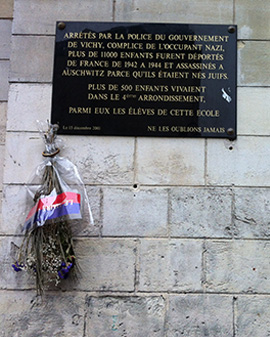
Plaque outside the Memorial de la Shoah

When not at the BNF I go to Nanterre, repository of many resistance archives, to immerse myself in yet more harrowing accounts of women in concentration camps or in factories working as slave labourers, or to the Holocaust Museum, where the librarian explains why she often does not have what I am looking for “because we deal with death not life, and with the nobodys in life who have no one to come and deposit papers with us.” And as I am finding my way around the city to a number of other resistance museums or repositories of World War Two papers, I can see why so many Parisians complain about passenger safety on the underground.  The short amount of time the metro doors remain open at stations is a source of regular complaint and this week I was one of those ‘snapped.’ The automatic doors close violently and stop for nobody. I was trailing my very small suitcase trying to get through the crowds when bang – they shut on me, poised halfway out, causing instant rib pain. But at least I got out and sat down to recover my breath. I’ve done nothing more than bruise a rib but it’s very painful. Very painful? How do I dare even to write that as I research lives that were truly, achingly, desperately painful, often with little or no food or heat and full of fear, threat and torture. Yet few complained.

Best of all are my interviews with old people who have lived through the experiences. I’m keeping the best details of these for the book itself but one memory that will stay with me is meeting two friends, one almost 90 the other a little older, comparing memories. One says to the other: “But you – you were in the resistance, no?  I never knew. All these years. Why didn’t you talk about it?”

“What was there to talk about?” she replies. “It was just what one did.” Again and again, I ask myself, what I would have done? Courage, like pain, are just two words I need to understand better in French as well as English.