Blog

Category Archives: History

New Zealand Women

Photography by Bev Short part of her All Woman exhibition

Photography by Bev Short part of her All Woman exhibition

In 1893 New Zealand became the first country in the world to give women the vote. After two decades of campaigning by women such as the Liverpool-born Kate Sheppard, who was also a temperance campaigner, politicians believed that empowering all women in this way might have a positive effect on morality in politics or even controlling men’s drinking habits. It was another twenty five years before Britain gave its female population – and then only those over 30 – the right to vote.

So, no surprise then that the New Zealand Portrait Gallery in Wellington has just opened a striking exhibition of photographs called All Woman * by another British immigrant, Bev Short, a Plymouth-born mother of two daughters, who came here ten years ago and says her aim is to create a debate about what it means to be a real woman today.

Her exhibition was opened by Melissa Clark Reynolds, once an impoverished, teenage single mother who struggled to finish her education, became a millionaire aged 35, and now works as an entrepreneur, philanthropist and climate awareness evangelist. It features women as disparate as a tattoo artist, sheep shearer, violinist, lance corporal in the NZ infantry, fire fighter, electrician, orthopaedic surgeon and a former Miss Zealand, mostly in unexpected poses not necessarily related to their work.

According to an introduction from Helen Clark, New Zealand’s first female Prime Minister who served from 1999 to 1980 and is currently administrator of the United Nations Development Programme, the UN’s third highest position:  “The show is a celebration of Kiwi women in the 21st century, some of whom … are redefining our idea of family and society, while others are making New Zealand proud on the international stage.” In 2006 Forbes Magazine ranked Clark 20th most powerful woman in the world yet few people outside New Zealand have heard of her.

Bev Short said the most shocking thing she discovered while working on the exhibition was the high incidence of domestic violence – against women and children. “I think that says something about the men in this society and it’s not just lower socio-economic groups or non-whites.”

Among the most powerful images is former international equestrian Catriona Williams, who represented New Zealand until she fell from her horse aged 30 in 2001 leaving her a tetraplegic. Yet instead of picturing her in a wheelchair, Short has her fully made up, with jewellery, wearing a magnificent red ball gown lying on a white sheet, her beautiful face radiating courage to her audience. “My ambition is to be able to dance with my husband once more,” she says. On the adjacent wall is Barbara Kendall, a retired windsurfing gold medallist now a motivational speaker, posed with curlers in her hair,  a phone in one hand, iron in the other, laptop open and child’s dress on the ironing board… a portrayal of multi-tasking with universal resonance for women.

*****

New Zealand is also famous for having relatively more book buyers per capita than any other country and this week The Forrests, the eagerly awaited novel by prize winning New Zealand author, Emily Perkins, was published and immediately needed to reprint.  The Forrests  has already been tipped as a likely winner of the Man Booker prize – at least by the Hay Festival where she is coming to speak in June. The last New Zealander to win the then Booker prize was another woman, Keri Hulme,  in 1985 with The Bone People .Perkins, who after living for eleven  years in London now teaches creative writing at Auckland University, is following in a powerful tradition of female New Zealand writers from Katherine Mansfield,  who  believed that power, freedom and independence were more exciting than love, to Janet Frame  (Angel at my Table)  and my own favourite, Margaret Mahy, whose brilliantly imaginative Lion in the Meadow I read night after night to my children .

Birthplace of Katherine Mansfield

Birthplace of Katherine Mansfield

Apparently this is precisely what Rudyard Kipling predicted when he came to New Zealand on a brief visit in 1891, according to his biographer, the New Zealand-based writer Harry Ricketts. Ricketts discovered a short story Kipling then wrote for the New Zealand Herald in which his narrator says, thinking of the future of Colonial literature, “Hark to the women now. They tell the old story well.”

*****

I am here to give a series of lectures about American women who shocked the British establishment including Wallis Simpson, Jennie Churchill and the so called Dollar Princesses, women who married into the British aristocracy trading money for titles. These women did not have careers and were often at the mercy of their parents who used them for their own social advantage. Katherine  Mansfield, born in 1888, certainly shocked the establishment. She wrote to friends of how she loathed the idea of  marriage as “The idea of sitting and waiting for a husband is absolutely revolting and it really is the attitude of a great many girls…” Perkins told me that although Mansfield and Frame were a major influence on her writing, “I see New Zealand’s female literature in the 21st century as a constellation rather than a linear tradition. It has opened up dramatically in the last twenty years.”

Anne Sebba is the author of That Woman A Life of Wallis Simpson (Phoenix £7.99)

Florida Diary

Anne standing on the steps of the house which belonged to the lawyer for Marjorie Kinnan Rawlings

'Anne standing on the steps of the house which belonged to the lawyer for Marjorie Kinnan Rawlings

Sitting in Orlando airport along with half of America’s school children (it is their ‘spring break’) I’m reminded of William Boyd’s observation that if you can’t see a six hour delay at an airport as an opportunity, don’t call yourself a writer.

I am in Florida, grandly billed as the English Speaking Union (ESU) 2012 Evelyn Wrench speaker, talking to a handful of American branches of the ESU. It’s all too easy to think of Florida simply as the sunshine state where elderly Britons go for winter warmth. Woken by mocking birds, fed breakfast of freshly picked and squeezed grapefruit and oranges while looking out on the tranquil St Johns River, I can see the charm of such a life. But, finding myself billeted at the House on Cherry Street, once the home of the lawyer advising Marjorie Kinnan Rawlings, the author who achieved worldwide fame with her Pulitzer Prize-Winning novel, The Yearling, I realise there is also a lively literary and artistic tradition. I had loved The Yearling, a powerful right-of-passage book about Jody, a boy who grows up with a pet fawn in the harsh North Florida backwoods, fighting off bears and alligators in order to survive. The book was translated into thirteen languages and turned into a 1946 film starring Gregory Peck.  But Rawlings faced a devastating lawsuit over her subsequent book, the autobiographical Cross Creek, so she was often in this house.

Cross Creek, published in 1942, was also an enormous success and chosen for Book of the Month club. But Rawlings had taken a real character, Zelma Cason, a close friend, and written of her as having ‘violent characteristics of both man and mother,’ a woman not afraid to curse when angry. Zelma, furious at her portrayal, sued for invasion of her “right of privacy,” even though the work was autobiography. The State of Florida had not recognised the existence of such a right so this was test case in a variety of ways, not the least important of which was that the attorney for Zelma was Kate Walton, one of the first women to practise law in Florida at a time when women could not even serve on a jury. Rawlins felt deeply that she had to fight for the right of all writers to write truthfully about their own lives. Although she won the local court case, she lost on appeal at the state supreme court – with damages of one dollar. After five and a half years of tortuous legal proceedings, Rawlings was destroyed, never wrote another successful book and died in 1953.

*****

At lunch I hear about Jacksonville’s links to the musician Frederick Delius, who in 1887 wrote the Florida Suite, a highly impressionistic piece of music which drew upon the sights and sounds he had experienced during the almost two years he spent living in the shadow of the St Johns river, listening to negro spirituals sung by the dockhands as they worked, a sound not used in European music previously. It was his first major work and heavily influenced by Afro-American music. Delius, born in Bradford in 1862, had been sent to Florida by his prosperous wool merchant father hoping to turn his son into a businessman rather than a musician. The family owned orange groves and Delius lived on a plantation at Solano Grove where he fell in love with a black plantation worker and allegedly fathered a child with her. Delius returned to Britain, confirmed in his desire to be a musician, and soon married the artist, Jelka, an unconventional and largely unhappy marriage. His final composition in 1931 was Songs of Farewell, a magnificent choral and orchestral work based on the poetry of Walt Whitman. Delius died in 1934 but Jacksonville holds an annual Delius Festival dedicated to his memory.

*****

The ESU is also involved in perpetuating memories, not just of Sir Evelyn Wrench, a man who devoted his life to furthering international understanding, but by sponsoring a Shakespeare competition among schoolchildren and by honouring Winston Churchill. After Jacksonville I go to Naples, one of 72 American branches of the ESU, a beautiful town that has grown up from a fishing village on the west coast of the Gulf where I am speaking at the annual Churchill Dinner. My final stop is Miami. “Oh my dear, that’s the west coast. You won’t like that nearly as much,” the folk from Naples tell me. These nuances are important here. But in fact I love Coral Gables, a Miami suburb which grew in the 1920’s around the magnificent Biltmore Hotel. The hotel has finally been refurbished after a spell as a hospital during World War Two and various owners and is now a favourite destination for Bill Clinton among others. In the late 1930’s Wallis and Edward loved to stay at the Biltmore with its championship golf course and legendary dinner dances teeming with celebrities. And I love Palm Beach, where everyone has a “Dook and Duchess” story they are desperate to tell me – what she ate (or didn’t), what she said and what she wore. At one of the many Palm Beach beauty salons I meet the man who often styled Wallis’s hair when she dropped in to the eight-storey Elizabeth Arden salon on New York’s 5th Avenue. He tells me how staff there were instructed to address her always as ‘Your Highness’ and how the salon had a special robe for her with HRH – initials she did not own – embroidered on the pocket. After her treatments she would walk out without paying, dressed to the nines in an elegant Chanel suit, to continue shopping.

Anne Sebba is the author of THAT WOMAN  A Life of Wallis Simpson Duchess of Windsor (Phoenix £7.99)

New discoveries… after publication

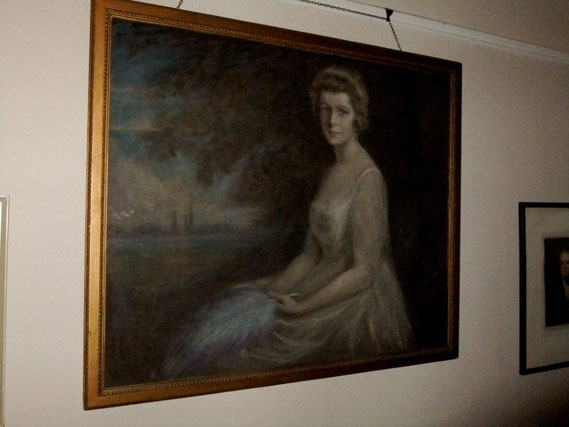
Mary Kirk Raffray picture in Edinburgh

It’s impossible to predict exactly what will emerge on publication of a biography but, rest assured, someone will tell you something you wish you had known before.

So, the letter that arrived telling me of the existence of a beautiful portrait of one of the key characters in my biography of Wallis Simpson, Mary Kirk, was both a thrill and not exactly a surprise. This week I travelled up to Edinburgh to see it.  It is a large (3.5 X 4 ft) pastel,  apparently commissioned by her soon-to-be husband,  the dashing Frenchman Jacques Raffray and, according to family lore, painted from photographs. It was intended as an engagement present for Mary and Jacques but never sent to America. The artist was Raffray’s aunt  ‘Minnie’ Rutherfoord – (Minnie’s sister had married Jacques father)-  a professional with a number of works accepted for the Royal Scottish academy exhibitions between 1895-1920. This was to be the last one she showed there in 1920 and bore the rather curious title ‘Down in the Forest’ curious because the background is more of a lake than a forest.

I had always known Mary Kirk was beautiful but the only pictures I  could find for my book showed her in her middle years.  Still attractive but rather matronly, the inevitable (and fashionable)  cigarette dangling from her fingers. This portrait would have been much more striking and perhaps better explained her story. She was a childhood friend of Wallis but travelled in Wallis’s slipstream and manipulated by her. Eventually, when Wallis was looking for someone to occupy husband Ernest while she was off on holiday with the King,  Mary and Ernest fell in love. It’s not hard to see why.

The picture, approaching its own centenary, is in good condition although a little faded. Moving or cleaning it might destroy it. The present owners , relatives of the artist, have always known something of the sitter’s history but  it was seeing Mary Kirk in C4’s The Secret Letters, the recent documentary based on my book,  that stirred them to contact me in the hope of discovering other Kirk relatives .

I have puzzled over why this beautiful portrait  was never sent to Baltimore. Perhaps its size or delicacy made that difficult but surely not impossible. Or was it because the marriage between Mary and Jacques soured more quickly than I realised?  I doubt this because Mary always wrote in affectionate terms of Jacques, even as she contemplated divorcing him. But who knows? I am certain that,  had Mary known of the portrait’s existence once she married  Ernest in 1937 and was living in London and especially after a warehouse fire destroyed many of their most precious possessions,  she would have wanted it in their house in Upper Phillimore Gardens. Mary  died of cancer in 1941 leaving a two year old son who later changed his name and moved abroad.  He too never knew anything about the portrait,  which has now acquired a life and a story of its own.

On this day 90 years ago

Ninety years ago today Jennie Churchill, American mother of Winston, died. She had fallen down the stairs after slipping on some high heeled shoes which had not had their soles adequately scored. At first it was thought she had just sprained an ankle but then gangrene set in. She had the lower leg amputated and for a while it seemed as if she would recover. But on June 9th 1921 she suddenly haemorrhaged. Winston famously ran through the streets in his pyjamas to be with his adored mother before she died. She was just 67 and still radiating the energy and vigour which made her so attractive to younger men.

Although married to Montague Porch, a Nigerian civil servant, she was still known as Lady Randolph Churchill and buried, as she had requested, at Bladon churchyard just outside Blenheim Palace because she wanted in death to lie next to her errant first husband, Lord Randolph Churchill.

Not so ancient history on Crete

Seventy years ago next month, one of the bloodiest battles of World War Two began. German paratroopers landed on Crete on the morning of May 20th 1941. They encountered fierce opposition from Greek and Allied forces, including many Anzacs, and at first it looked as if the invasion would be a Nazi disaster. But, in spite of suffering appalling casualties, after ten days the Germans conquered the island. For the next four years the Nazi invaders encountered some of the fiercest resistance from a civilian population anywhere in Europe. The retaliation was brutal and has left lasting scars.

It is impossible not to think of those years as I wander around the small square at the south end of Kondylaki Street in Chania, the beautiful port town of Eastern Crete where I am staying. As soon as the Germans seized the island they demanded a complete list of all members of the Jewish community on Crete which then totalled around 300. Three years later, by then swollen with refugees from other parts of Greece, they were all rounded up. At dawn on May 29th 1944 the entire area of the old town was blocked off by trucks as loudspeakers ordered the Jews out onto the street. Allowed to take nothing with them, they were herded into the square today full of cafes pulsing with life and shops selling vibrant clothes and gaudy souvenirs. They were driven to a nearby prison where they remained for two weeks with little food and no changes of clothes while their homes were looted. Finally, on June 9th they were all loaded onto a converted tanker en route for Auschwitz via Athens but were torpedoed by a British submarine targeting German ships and all drowned.

The Jewish presence on Crete, dating back to the 4th century BC not long after the conquest by Alexander the Great, was wiped out in one day. The ancient synagogue of Etz Hayyim, although much looted and attacked over the years, is all that remains. For the last decade there has been a determined effort to revive Jewish life in Chania and on the eve of Passover a local restaurant hosts a community Seder, or Passover meal, which attracts a motley crew of Greeks and tourists, both Jewish and not. I sat next to a Russian who was next to a half Greek half Turkish man , not Jewish, but who said he came because he liked to celebrate the revival of Jewish life. Another guest felt guilty that the local community had not been able to do more in 1944.

Later this month there will be commemorations of the Battle of Crete in various parts of the island perhaps the last time that anyone who was alive at the time will attend.