Blog

Category Archives: History

Playing a role in an Original Greek Drama

Anne Sebba Meets the Mayor of Aghios Nikolaus

Anne Sebba Meets the Mayor of Aghios Nikolaus

I came closer to understanding what it means to be part of a Greek tragedy last week. I’m not talking about Aeschylus or Euripides of course but today’s everyday tragedy for many Greeks who feel that the rest of the world despises or is mocking them and has many of the elements of traditional Greek drama. There are the conflicting emotions of fear and pity and conflict between men as well as between nations, but so far no catharsis.

“What is happening in Europe today doesn’t represent the original European spirit, which is the spirit of cohesion and solidarity,” explained Dimitris Kounenakis, Mayor of Aghios Nikolaos, a region of Eastern Crete long beloved by tourists, especially Brits.

“At the moment there is a division between northern Europe and southern Europe and we would like just one Europe, for rich and poor alike, not one exploiting the other.”

It happened like this. A Greek friend who knew how much my husband and I loved Crete, so much so that we have built a home there, introduced us to someone whose job is to make sure the deprived and disadvantaged, women and children on the margins or in violent and abusive relationships, are aware of all the projects and initiatives that exist to help them. The idea is to make sure that local people know that the European Union is not all about road building – although there is plenty of that – but has some very tangible benefits to help those in need. She mentioned us to the Mayor and he wanted to thank us for our confidence in the region by inviting us to a moving little ceremony in his office overlooking the Marina. The original friends were there, luckily interpreting and translating as my beginner’s Greek stretched no further than a brief sentence thanking the Mr Kounenakis for bestowing on us such an honour.  I hope he understood what I was trying to say as the day before,  in the butcher’s, I had apparently asked for hen rather than chicken and on a mountain walk, asked a man with a donkey how old he was, meaning of course the donkey but used the wrong pronoun. I received the Greek equivalent of a very old fashioned look.

Reverting to English, I told the Mayor why I loved the island so much; for its history – the idea that paths I tread have been trodden by countless others for thousands of years – for its food, and for its people. I cannot imagine a better place for a writer to work that is both stimulating and peaceful.  The ancient myth may warn ‘beware Greeks bearing gifts’ but we welcome them! Greeks are the most generous people imaginable with homemade cheese or spinach pies appearing at all times of day and night. I dare not think how long it must take some kind person to prepare these delicacies.

Then it was the Mayor’s turn again and he explained to us all the activities he has undertaken to preserve and improve the environment in the region within his jurisdiction, pointing out that there are now 23 ‘Blue Flag’ beaches, denoting that they meet stringent criteria for biodiversity and sustainable development.   And then we were joined by a Greek chorus of journalists and a local TV film crew who wanted to record the moment when we were presented with a certificate and two bottles of Cretan olive oil, and I presented the Mayor with a copy of one of my books and we repeated once more why we think we have discovered a corner of paradise.

Greece may recently have been overtaken by Cyprus and even Portugal as Europe’s problem child but that does not mean the Greek crisis has gone away. Some people think we must be mad to have a house here but, in a land where antiquity surrounds you on all sides, it’s hard not to believe that the country can withstand one more drama-  if not drachma. Life on the ground is good, the sun shines most days and Crete is such a lush and fertile island that most of its inhabitants can grow much of what they need so won’t starve. But for many without jobs, especially in towns on the mainland, life is still painful. And most painful of all is being lectured to by Germany; history is short and memories are long and in Crete of all places, the Nazi Occupation from 1941 to 1944 was harsh and brutal.

Anne Sebba Meets the Mayor of Aghios Nikolaus

Anne and Mark Sebba Meet the Mayor of Aghios Nikolaus
Footsteps Biography

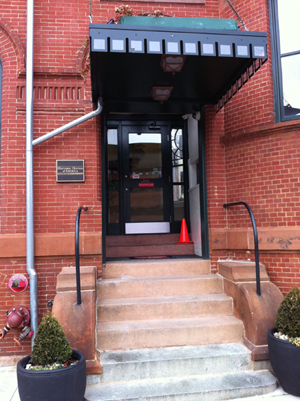
Footsteps biography doesn’t get more real than this. Young Wallis Warfield, barely ten years old and fatherless, lived in this building in Baltimore where I have just spent a night. Many times she walked up the same red brick-edged steps that I just have, with a heart – by her own account – almost as heavy as my suitcase.

Brexton Hotel Steps

Brexton Hotel Steps

It was around 1905 that Wallis and her widowed mother, Alice, moved in to the Brexton lodging house, built in 1891 on a strange corner plot with 58 bedrooms and only a handful of shared bathrooms. The time they spent here was deeply unhappy for them both. Wallis recalled later how she endured meals alone with her mother, bathrooms shared with other tenants “and rather forlorn excursions” to the Warfield family house on East Preston Street, the smartest part of town, that they had just left. Probably they had fled in a hurry because her late father’s brother, Uncle Sol, on whom they depended for money, had made unwelcome overtures to the beautiful Alice. As keen-eyed Wallis noticed, there suddenly descended a mysterious and disturbing barrier preventing discussion of anything connected with the family mansion. Read More

Travelling for Work

Travelling to work takes on new meaning when you have to make a day long journey for just an hour of work, the length of a lecture.

Saltaire

Saltaire

Last week I left home before dawn to get down to Cornwall but hit trouble as early as Reading station. Standing in the freezing, snowy cold, trains were constantly cancelled, changed or delayed because of the floods that had hit the West Country the week before.  The force of the water had dislodged several lines that ran close to rivers and so, although the tracks remained, the ballast underneath them had been washed away in many places.  New landslips were being reported as I stood there. The poor beleaguered train staff did their best and in the end advised anyone to take whatever train was on offer if it was going approximately in the right direction. I did and with a coach ride, plus diverted train, plus car arrived eventually at Fowey by about 5 pm. I quickly changed, gave my lecture on behalf of the Fowey Harbour Heritage Society and went to bed. I left at dawn the next day, happy I’d done what I’d been asked but sad I didn’t have longer to enjoy this beautiful part of the world.

This week I went in the other direction, to Saltaire, the model village just outside Bradford built by mill owner and philanthropist Titus Salt in the early 19th century to improve the lives of his workers. Saltaire is now a Unesco World Heritage Site and the vast Salt’s Mills alongside the River Aire are home to a spectacular collection of paintings by David Hockney, the almost local boy who studied at Bradford School of Art before going to London and the Royal College of Art. Read More

Following in famous footsteps – Farewell from the Blue Mountains

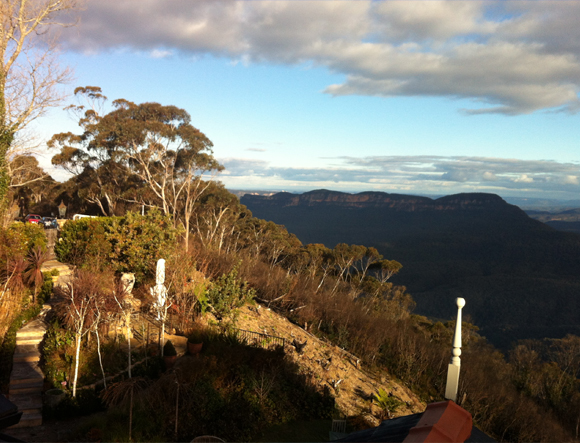
Blue Mountains

Blue Mountains

Lilianfels and Norman (magic pudding) Lindsay

On my last Sunday in Australia I make my way to Sydney Central train station. After an hour’s journey on a rickety old train full of graffiti, as well as hikers with rucksacks eager to get to the mountain trails and cliff walks of the World Heritage listed Blue Mountains National Park, I get out at Springwood. I feel a rush of cold air but it’s wonderfully fresh. I am grateful for the gloves I have carried all around Australia, unused until now. Suddenly it is winter, strange in May.

No wonder so many Victorian travellers came here thinking a blast of mountain air would cure them of all manner of ailments especially Tuberculosis or consumption as it was then called. Nowadays, the place to stay is Lilianfels, a luxury spa hotel owned for a decade or so by a Japanese group but originally the home of Irish born Sir Frederick Darley, Lieutenant-Governor and Chief Justice of New South Wales (NSW).  Sir Frederick and Lady Darley came here with their family in 1888, bought some land in the neighbourhood of Katoomba for “the erection and completion of a high class cottage.” They certainly achieved that, although the cottage could not deliver the hoped for cure for their beloved daughter Lillian. She died on April 21, 1889 aged 22 and the house was named in her memory with the word ‘fels’, a high rock in German, added to indicate the surrounding area. Sir Frederick sold the property in 1908 and the house went through a variety of owners after that.

Nonetheles  Lilianfels, with its broad sweeping driveway so typical of hill station estates, evidently remained a popular Blue Mountains resort. According to one early 20th century advertisement it was a “charming guest house of historic interest, sunny yet sheltered. It immediately overlooks majestic cliffs and has a clear and uninterrupted vista of the Jamieson and Kanimba Valleys. Lilianfels is not modern,” the advert continues, “the site was chosen and the quaint old fashioned residence built by Chief Justice Sir Frederick Darley over a century ago and there he entertained royalty on several occasions.” Queen Mary visited in 1901 and, twenty years later, her son then Prince of Wales, later Edward 8th and later still Duke of Windsor (about whom I have spent so much time talking in Australia this month) went there.  Edward came as part of his 1920 tour, intended to proclaim to the Dominions that, in spite of the recent Bolshevik massacre, the British monarchy was safe in the hands of this handsome charmer. During his brief stopover, Edward, a keen gardener, found time to present Ranger McKay with a long service medal in the grounds of Lilianfels as he admired the glorious landscaping of the park.

I long to go back here not only for some serious trekking in the valley of the Three Sisters mountain peaks but to ramble around another Springwood estate, the home of the artist and writer Norman Lindsay (1879- 1969) and his muse and wife, Rose Soady. They moved to the Blue Mountains in 1911 hoping to cure Lindsay’s presumed tuberculosis. The property where he lived and worked for nearly 60 years, called Springwood, is now owned by the National Trust of Australia and the original sandstone cottage, which Lindsay and Rose extended and embellished to suit the growing needs of their family- (daughters Jane and Honey were born in 1920 and 1922) – now houses a gallery for the permanent exhibition of his work. Several of his cement sculptures still decorate the magnificent 42 acre garden with some now cast in bronze to preserve them. Lindsay wrote his classic Australian Children’s story, The Magic Pudding, in response to a wager:  he believed that children were more interested in food than in fairies and he was evidently right. The Magic Pudding may not be his most significant artistic creation but it has never been out of print.