Blog

Category Archives: Uncategorised

Paris in the springtime

Worth La Belle Dame sans MerciParis in the springtime may be a romantic cliché but the day I have just spent in the city was everything the song promised. It was one of those blue sky sunny days which offer so much hope for the summer to come. And it was in the middle of Paris fashion week so the city was full of statuesque women wearing platform soles and 6 inch heels, painted nails and powdered faces, bizarre hair styles and outrageously wonderful clothes. There was also a half marathon so hundreds of muscular types were wandering around looking dazed in their blue plastic wraps declaring their achievement. And of course, the inevitable Paris traffic chaos.

Paris is fighting hard to keep its title as the fashion capital of the world. London, bursting with the creative fashion talent of so many young British designers, is intent on chasing it into second place. But as one designer described it to me: ‘Paris is still where you are judged at the highest level. To succeed in Paris is still the greatest challenge.’

He has a point. Somehow Paris has an allure, an allure that perhaps still trades on its glory days of The Belle Époque, the days when rich Americans with shiny new fortunes would bring their daughters to Paris to give them some old world polish, hoping to take the brassy look off their very nouveau fortunes before launching them onto impoverished British aristocrats. They were the dollar princesses and nothing defined their superiority over their English sisters better than their fabulous clothes and their ability to wear them with style, ease and confidence. They knew how to cause a stir when they entered a room. Edith Wharton advised any young American girl preparing for a grand marriage to have approximately eleven Worth gowns in her trousseau; Jennie Jerome had twenty three, a fact which caused her fiancée, Lord Randolph Churchill, no end of difficulties in finding a house big enough for them all.  Wharton also advised young women to keep this year’s model for a year before wearing so as to let the ostentation fade a little.

Charles Frederick Worth, born in Bourne, Lincolnshire in 1825, an Englishman who reinvented himself in Paris, is the man responsible for establishing the idea of haute couture as we know it today. Blame him for the idea of a brand as he labelled all his creations – a small critical rectangle of fabric usually sewn in the waistband – cultivated an international clientele of aristocrats, royals and actresses and plenty of mystique. He saw himself as an artist and created out of the commercial transaction of buying a gown a theatrical experience. But he also had responsibilities to ensure that his aristocratic clients never encountered his courtesan or actress clients, of whom there were many. Some of these were given a special prix d’artiste, the forerunner of film stars borrowing gowns from famous houses in the hope of bringing them fame.

In 1850, just as Worth was starting out in Paris (he had left England just five years before and was not yet established) there were an estimated 158 couturiers in Paris and 67 maisons de nouveates confectionées. By 1895 that figure had risen dramatically to 1,636 couturiers and 296 maisons de nouveates confectionées, the best of them, as Maison Worth, clustered around Place Vendôme and Rue de la Paix.

This week sees the publication of a fabulous book about Worth* with truly lavish illustrations thanks to the Victoria and Albert’s unique archive of over 7,000 official house records. And it is full of interesting tidbits. On one occasion Grace Elvina, the Marchioness of Kedleston and a loyal Worth client, found herself wearing an identical Worth gown as the Queen of Spain, a woman she had invited to dine at her home. She went quickly upstairs to change and chided the master afterwards. But he was not especially penitent. He did not need to be.

One of the loveliest museums in Paris is the Musée Carnavalet, in the fashionable Marais where it is always a pleasure to be a flanêur, currently has an exhibition entitled **Roman d’une Garde-Robe, or Tales from a Wardrobe, which brings alive in a wider sense the world of haute couture in Paris for its privileged clientele and those who served them.  The show is based on the wardrobe of Alice Alleaume, head saleswoman at Chéruit, rival to Worth and in fact the first couture house to set up in Place Vendôme. Her sister, Hortense, was head saleswoman at Worth. The whole family was immersed in fashion and the exhibition brilliantly captures the spirit of la Belle Époque as well as the freedom of the twenties and the difficult years of the depression. It’s especially good at showing the links between artists and photographers who were clearly fascinated by elegant Parisiennes who shopped not only at Worth but at Paquin, Doucet and Chéruit and one painting illustrates how a whole family would be involved in the dressmaking process – children too. Dressing to the best of one’s financial resources is a tenet deeply engrained in the psyche of a Parisienne. It’s a sacred duty, what they owe themselves. But, oh, where did they find the time for all these fittings and  regular changes of outfit throughout the day.

Parisian haute couture did not end in 1939, with the outbreak of War, nor even in 1940 with the German occupation.  Lucien Lelong, President of the Chambre Syndicale de la Haute Couture had to negotiate with the occupying German regime. He courageously refused Nazi demands to take the entire couture industry to Germany and made a spirited fight to keep Parisiennes well-dressed in gowns made by French houses as well as hundreds of seamstresses working in small ateliers. But there were also important sales to Nazi wives which helped keep the industry alive during the war years but meant that after liberation some couturiers were tainted with the collaborationist brush. Thus the flame never burned out and after the war Christian Dior with his ‘New Look’, but others too, breathed new life into an industry vibrantly alive today.


*The House of Worth Portrait of an Archive V& A Publishing  £35.00

**Roman D’Une Garde-Robe  Musée Carnavalet until March 16


The Pram in the Hall – Enid Bagnold Writer and Mother

gaudier-brzeskaA talk I gave recently at the October Gallery – The annual Persephone Lecture

I have never thought it a particular advantage to know the person you are writing about. You will have known them at a particular time or in a particular role. Above all, for a child to write about a parent seems to me a recipe for disaster – unless you state from the outset this is a very one sided memoir. Children are often the least useful witnesses a biographer can find. Yet, try as we might to be objective, I think biographers too should plead guilty to subjectivity, to seeing their subject through a particular prism. Perhaps they lived in the same village, studied at the same college but in particular I believe that what we really cannot shed is the age we are at time of writing. However much I think I can imagine a particular emotion, or I am sure that I know what a particular experience must have felt like, I want to take this opportunity – openly and unequivocally – to admit my failure. Only now, having hit 60 myself and living through an age-obsessed time when the secret of eternal youth is promised from many quarters, do I really understand what Enid Bagnold – not exactly a vain woman but one who cared about her looks – meant when she wrote that one of the few counterbalancing factors for the pain of growing old was that, thanks to fading eyesight, she couldn’t really see all those wrinkles and grey hairs that worried her so much in anticipation – (although true to her novelist’s calling, exaggerating to make her point – she is not being wholly truthful even here as of course magnifying mirrors were around in the 1980’s.) But I can now at least understand why she wanted to have a face lift (and how radical was that in the 1970’s) and I admire her honesty and truthfulness about discussing this far more today than I could possibly have 30 years ago.

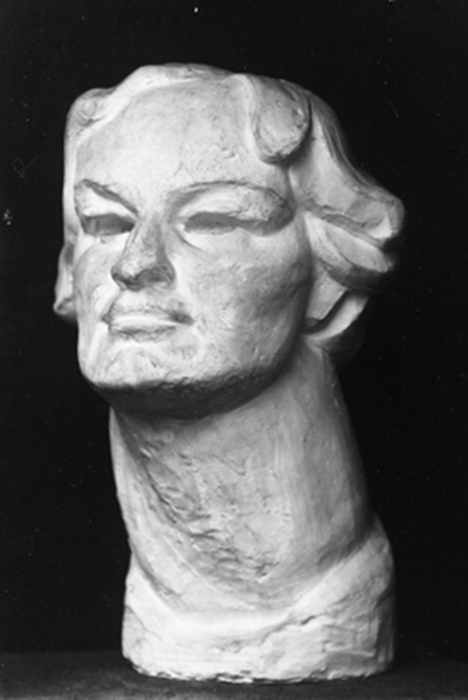
And here she is as Gaudier Brzeska saw her on the eve of WW One

So, I am immensely grateful to Persephone for giving me this second chance to look at Bagnold thirty years on. And of course to Faber Finds for republishing my biography. I’m relieved to say I haven’t found a different person or a different story. But the focus, if I were writing the book today, might be slightly sharper here or hazier there. The emphasis on different aspects of her life might be weightier here and pruned there. Actually I don’t think it would be a better book (I would say that wouldn’t I?) But I now understand in a wholly empathetic way why, in her 60’s and 70’s, she was still burning with ambition to write a successful play. I remember, with shame, a feeling in my 20’s that when I reached 60 I’d be happy to stay at home quietly knitting whereas in fact my desire to travel, to meet people, to achieve and to experience life is not only unabated it is in some ways greater as I am acutely aware of the limited time left and…and I can see why it risks appearing frankly unbecoming in someone of my years just as it did for Enid.

No, I think, or at least hope, that writing the biography of EB in my late 20’s gave me a youthful enthusiasm which suited my subject and gave me a perspective on her young days and early married life I might not have had now. I was rooting for her when the boyfriend didn’t work out (after all it wasn#39;t so far away for me that I could still remember those rejections, sharp longings and early fumblings) but most of all I deeply identified…and I say this fully aware of strictures by that great biographer Richard Holmes that self-identity with one’s subject is the first crime of a biographer…with her passionate desire to have babies and having had them to have more of them and then to be the best mother there had ever been. I understood the passionate and oh so unexpected flood of love when her first golden-haired child arrived – love neither she, nor I, knew we possessed. And then she found it a second time for her equally beautiful son – just as I was to do. My pigeon pair as I learned. The Squire, her truly great novel not just about motherhood but about what she believed it meant to be a woman, springs from that deep well of unconditional love. Enid wanted to go on and on, bringing up such treasures.

The Clifford Sisters for Femail Writer Enid Bagnold picturedSo let’s go back a bit. Who was Enid Bagnold? In her own sparkling and idiosyncratic autobiography (entitled I am tempted to say with no artifice but of course there was artifice aplenty) ‘Enid Bagnold’s autobiography’, published in 1969, she writes that she was driven to explore family history because of her fascination that “sperm had been shot across two centuries to arrive at me”. Such an earthy – and original – simile was typical of her writing (she once described her own prose as ‘beautiful vomit’) but what she is also revealing is an intense fascination with herself. Not unusual for ‘a born writer!’ as she called herself. When I came to research her biography I found all her notebooks and scrapbooks were embellished with directions/ guidance for a putative biographer – me! Pictures of the Franco-Romanian princes, Antoine and Emmanuel Bibesco, for example, princes who had been close friends of Proust, were annotated with helpful comments like ‘this is the brother who committed suicide’ or ‘here we are visiting a church together’!
But Antoine Bibesco, the man she always adored, was never going to marry the plump and rather jolly Miss Enid Bagnold, daughter of Colonel Arthur Bagnold, a man who was as much engineer as soldier, and the former Miss Ethel Alger. They were, as her parents regularly reminded her, gentlefolk, and had been for generations. Enid was constantly testing her parents either by her requests to paint nude models when she studied with Sickert (turned down) or her request to visit the old roué journalist Frank Harris, her editor as well as lover, when he was in Brixton prison – agreed to “because people of breeding do not abandon a friend in need,” her father told her. Read More

Confused in Berlin

Train Station memorial

Berlin Gleis 17

A weekend in cold and wet Berlin has left me confused.

Can you (should you) make art out of suffering and if so what is appropriate where and who should pay?

Why do I find tourist maps offering tours of Jewish Berlin, tours of Nazi Berlin, tours of ‘fun time’ Berlin offensive … Are we doing the murdered Jews any favours by offering tours of a destroyed civilisation?

Should there ever be a time when tourists will come to Germany and not think about the holocaust that tried to wipe out the once flourishing Jewish presence there?

Well, actually, I don’t have any answers to these questions but they have all been refusing to lie low these last few days. When I looked vacantly at someone today as she asked how my trip had been I explained: I was still feeling rather churned up after my visit.

Oh Berlin is one of my favourite places, she riposted. The Berliners did so much to try and stop the Nazis you know…the big synagogue survived because a brave Berliner prevented the mob …

Stop, I said. I did not want anyone else telling me what to think. But perhaps she was right.

Were there in fact dozens of good Germans rendered powerless by fear and the need to survive who were merely forced into inaction by a tiny minority?  Some 55,000 Berlin Jews died in concentration camps, but approximately 80,000 escaped.  A visit to the small brush workshop run by Otto Weidt for blind Jewish workers moved me most of all partly because it seemed hardly to have changed. Surviving letters, yellow stars and photographs were in simple display cases the tables for the machines with which he made the brushes needed by the German army were in the places they had always been and the wooden floorboards in the secret room still so creaky that my heart lurched. I came as near as I possibly could in the prosperous 21st century to  imagining what it must have been like to hide in a tiny airless room entirely dependent on the kindness of strangers for a mouthful of food, news, clothes everything. A network verging on a hundred brave people was apparently, sometimes necessary to save one life bearing in mind all the bribes and blackmail and lying involved.

This room in a graffiti-rich, little renovated courtyard in former East Germany was an extraordinary survival with no artifice about it. But was it really: “One of many places in Berlin where non-Jews risked their lives to save their Jewish neighbours,” as one guide book stated?

Germany has for years been the most contrite of nations, admitting its guilt in numerous ways and welcoming Jews back.  Berlin today is a vibrant and growing community with thousands of Jews mostly from Russia and Israel now choosing once again to settle in Germany.

You can’t walk around this city without stumbling on a brass plate in any of the cobbled streets Stolpersteine indicating who once lived there and where they were murdered (yes, murdered no soft talking references to dying here) It is a private initiative paid for by anyone who cares, not the government – local or national. But this too has its opponents …should you be trampling on these souls, as some critics complain or since they have already been killed, what more can you do to harm them? Several of the monuments are on steps and one of the most moving for me was a cartouche of names visible on the upward tread of stairs in a once Jewish quarter indicating names and places of abode.  It is termed an installation, a term which I liked less and less…this can never be art. But alongside the steps and at the top are mirrors acting as an extra reminder. You cannot exit this particular U Bahn station without noticing something.

But by the time I came to Daniel Liebeskind’s Jewish museum I was starting to feel uncomfortable. It is magnificent and clever but it is very definitely art and, what’s more, art subtly manipulating your responses. Why are the objects displayed in a cabinet with a circular glass surround?  The shape of the building is interesting as it traces a path leading to the Stair of Continuity, then up to and through the exhibition spaces of the museum, emphasizing the continuum of history. The second leads out of the building and into the Garden of Exile and Emigration, remembering those who were forced to leave Berlin. The third leads to a dead end — the Holocaust Void.

The Holocaust Void is cold and empty and unpleasant. But I left it of my free will after five minutes.

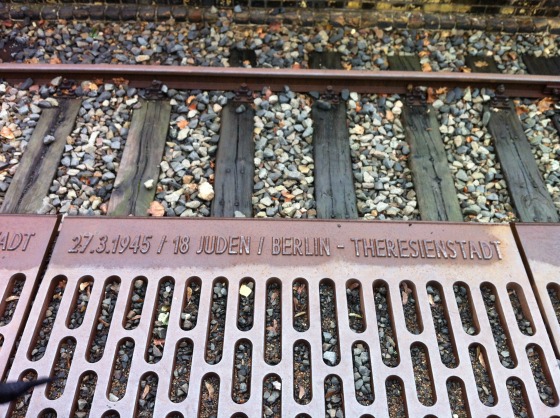
I think Berlin and those who have planned some of the memorials have on the whole done an impossible job with tact, sensitivity and feeling. I was moved by the small signs of a phone a pet or a loaf of bread placed on posts in the former Jewish quarter to remind inhabitants of the daily torments suffered by their erstwhile neighbours prior to deportation  (After the Nuremberg Laws they were allowed none of these) And surely few can fault the way German history is taught, even to the very young, actively fostering greater understanding in schools, a point movingly made in the TV interview with Judith (When Hitler Stole Pink Rabbit) Kerr this week to mark her 90th birthday. Her father was a leading theatre critic and Nazi opponent and her family escaped Berlin swiftly in 1933. Although her parents never fully recovered from the pain of exile she and her brother were resilient, looking on it as something of an adventure. Her book is now a set text in German schools as the film showed. It also filmed her walking along Gleis (platform) 17 of the Grunewald station. Here the memorials are devastatingly plain and simple, the message unadorned. The numbers and dates of Jewish deportees have been carved at the edge of the train tracks where unknowing Jews stood before deportations to Auschwitz, Minsk, Theresienstadt or Sachsenhausen. Fittingly this memorial has been paid for by the train company which profited from the human traffic.

Kerr stood there in 2013 pondering what fate would have unquestioningly befallen her family had they not moved out as fast as they did. All of us who have enjoyed her books owe her brave parents a huge debt.

What Brighton means to me

One of the most powerful images from the Vienna Portraits exhibition currently at the National Gallery is by Egon Schiele of himself and his pregnant wife dying of Spanish ‘flu. He was to succumb to it himself three days later, aged just 28, later described by the Nazis as a ‘degenerate’ artist. I cannot empty my mind of this picture and the thought of all that lost brilliance. Yet in an exhibition where death is continually hovering and suicide ever present,  it’s impossible to know how would he have dealt with all that was to follow after 1918?

Between 50 and 100 million people across the world died of what became known as Spanish ‘flu.  One of the most shocking aspects was the way it could sometimes claim its victims in a day and was especially virulent among the previously healthy young.  After waking up with a shivery twinge, victims might find by lunchtime that their skin had changed colour to a vivid purple and a few hours later they were dead, sometimes choking on thick scarlet jelly that suddenly clogged the lungs. The pandemic has been described as “the greatest medical holocaust in history” and may have killed more people than the Black Death killed in a century.

I have often thought of this pandemic as my own aunt, my father’s older sister, Irene, died aged 12 in 1918. My father’s family had moved to Brighton hoping this would be safer than London because of the new terror of Germany’s doodlebugs. But Brighton, being a port, was in fact more dangerous as the disease was thought to have been carried ashore by travellers. My grandfather, a Lithuanian Jewish immigrant who had been in England less than 20 years, never recovered from the loss of a favourite daughter and gave up on joy and God.  They were buried with my aunt in a Brighton cemetery.

Brighton can never for me be simply a seaside resort.  I have always known that my father was deeply scarred from the loss of the sister he barely knew when he was six and the consequent suffering endured by his family for whom emotions must have been ‘unexploded’ and so I relished a book which looked at the town twenty years later during World War Two.  Alison MacLeod’s  Unexploded is partly about attitudes to Jews and immigrants in Britain at the end of the thirties but it is also a deeply felt examination of repressed emotions waiting to explode as of course they do in the course of the novel. The background history is fascinating, never intrusive, but there is plenty to learn here about politics and history of art. For example Picasso’s Guernica is on show at the Whitechapel Gallery from December 1938 to mid-January 1939, the hero, Otto,  is a ‘degenerate’ artist and Virginia Woolf, whose suicide frames the book, enters to give sparsely attended lectures. I shan’t tell the story but it’s a powerful, often painful, read and Evelyn and her defective husband Geoffrey are utterly believable protagonists.

One other book I have read this week is Robert Harris’s brilliant thriller,  An Officer and a Spy. In this retelling of the Dreyfus affair virulent anti-Semitism in France is overt, barely repressed and with consequences which have shuddered down the ages. Even those of us who thought we knew this tale cannot fail to see it through fresh eyes.


Hidden panels, dusty books, silence at all times? That’s not today’s library.


A romantic library

Stacks of Books Here

When John Bayley proposed to Iris Murdoch she suggested going somewhere romantic to discuss the idea…the London Library!

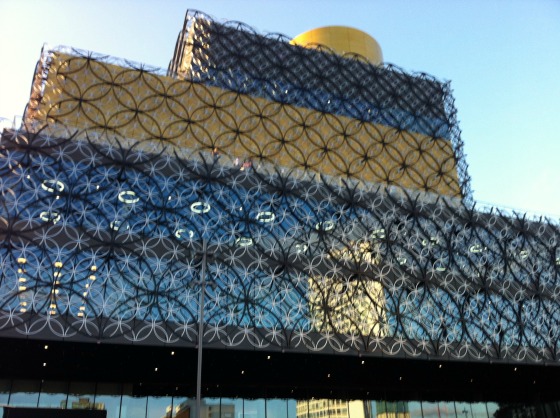
Last week, on the day it was opened, I climbed the neon escalator of the world’s newest library – the £189m Library of Birmingham, which over nine floors houses a collection of one million books, more than 200 public access computers, theatres, an exhibition gallery and music rooms! This is exciting at a time when public libraries are hit by the double whammy of government cuts and increasing use of the internet.

Birmingham library was formally opened by Malala Yousafzai, the teenager shot in the head in Pakistan by the Taliban for championing women’s rights. Malala spoke about how books were weapons to beat terrorism and how she believed that the only way to global peace was through reading, knowledge and education.

Where has this extraordinary young girl learned such composure and confidence? Through books, she insists. Some books travel with you back centuries, others take you into the future, some take you to the core of your heart and others take you into the universe, she said.

Looking at the fabulous collection here in Birmingham – its most valuable books are copies of Shakespeare’s First Folio and John James Audubon’s Birds of America – worth between £6m and £7m each- we can only hope there are more like her.  But it isn’t these books that will change the world, beautiful though they are. It’s ordinary stories, novels, biographies, philosophies and histories.  And the serendipity of finding something in a library is especially fun; who else has had pleasure in this book and what did they make of it?

The new Birmingham library is a stunning piece of architecture with roof gardens overlooking the heart of Birmingham and a wild flower meadow.  I am sure Iris Murdoch would have found it an intensely romantic place. Libraries aren’t just worthy places of silence any more they are vibrant, buzzy, humming exciting places to be. I’m glad that my own grandfather came to Birmingham from Krakow so that when I finally get around to writing his extraordinary story I shall have an excuse to research there. For the moment I shall continue to admire the steel girders eventually supporting my own personal library (well a study or an office, in truth) but it will house quite a lot of books that are very special to me so I am happy to call it, rather grandly – a library.  Really a library is just a nice place to be. Let’s have more of them.