
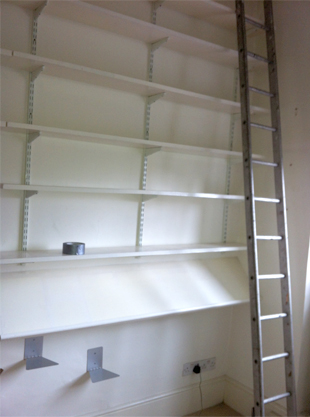
 After 20 years of accumulating detritus on a ridiculously wide range of subjects, I have finally been forced to clear out my study. It’s a grim business that I’ve been postponing for months. This is my private sanctuary, the room of my own where eight books have been written, and it’s the only room where the muse strikes, since I believe a muse is nothing more than concentration, wide reading and being near the laptop at the critical moment. But the builders are arriving tomorrow so no further delay is possible. I have done mini culls before; in fact there is a sort of ritual clearance after each book is finished, putting the mounds of documents and letters into a big plastic box away in the attic hoping no one will ever ask me to search for some obscure reference. But they invariably do and it’s not fun searching on my knees in the dark and dusty attic where wasps make their nest among a different set of rafters every summer. These days there is much less paper generated per book as so much of the information comes through email and is stored on various obsolete hard disks, so why do I feel the necessity to store the old paper version at all? Is there a cut off point, say five years and then shred? But in truth it’s not just the documentation for the books that I keep…I am guilty of keeping hundreds of copies of old magazines (or I did until last week when almost all found their way into the recycling lorry). And I cannot read a newspaper without tearing out pages, half pages or just a column making it impossible for anyone else to read a newspaper if I have got there first. But the trouble with old newspaper articles is that once you have kept them for a few years they acquire a hallowed importance way beyond what is actually in the words or story so then they cannot be thrown away. Mostly these articles go into a pink box labelled: ‘Keep for the novel’. But I have not yet written a novel. Is it because I know real life is always stranger than fiction.The box is staring at me now as I type this. Perhaps this is the moment? Read More
Category Archives: News, Events & Talks
Footsteps Biography
Footsteps biography doesn’t get more real than this. Young Wallis Warfield, barely ten years old and fatherless, lived in this building in Baltimore where I have just spent a night. Many times she walked up the same red brick-edged steps that I just have, with a heart – by her own account – almost as heavy as my suitcase.
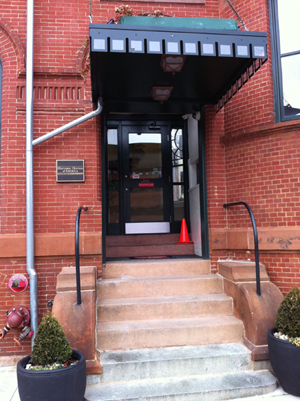
Brexton Hotel Steps
It was around 1905 that Wallis and her widowed mother, Alice, moved in to the Brexton lodging house, built in 1891 on a strange corner plot with 58 bedrooms and only a handful of shared bathrooms. The time they spent here was deeply unhappy for them both. Wallis recalled later how she endured meals alone with her mother, bathrooms shared with other tenants “and rather forlorn excursions” to the Warfield family house on East Preston Street, the smartest part of town, that they had just left. Probably they had fled in a hurry because her late father’s brother, Uncle Sol, on whom they depended for money, had made unwelcome overtures to the beautiful Alice. As keen-eyed Wallis noticed, there suddenly descended a mysterious and disturbing barrier preventing discussion of anything connected with the family mansion. Read More
National Libraries Day – Happy Birthday Melvil Dewey
As a schoolgirl I discovered Dewey and my love of libraries began there. Let’s celebrate him now as part of the National Libraries Day campaign, read my blog post here.

National Libraries Day - Happy Birthday Melvil Dewey
Travelling for Work
Travelling to work takes on new meaning when you have to make a day long journey for just an hour of work, the length of a lecture.

Saltaire
Last week I left home before dawn to get down to Cornwall but hit trouble as early as Reading station. Standing in the freezing, snowy cold, trains were constantly cancelled, changed or delayed because of the floods that had hit the West Country the week before. The force of the water had dislodged several lines that ran close to rivers and so, although the tracks remained, the ballast underneath them had been washed away in many places. New landslips were being reported as I stood there. The poor beleaguered train staff did their best and in the end advised anyone to take whatever train was on offer if it was going approximately in the right direction. I did and with a coach ride, plus diverted train, plus car arrived eventually at Fowey by about 5 pm. I quickly changed, gave my lecture on behalf of the Fowey Harbour Heritage Society and went to bed. I left at dawn the next day, happy I’d done what I’d been asked but sad I didn’t have longer to enjoy this beautiful part of the world.
This week I went in the other direction, to Saltaire, the model village just outside Bradford built by mill owner and philanthropist Titus Salt in the early 19th century to improve the lives of his workers. Saltaire is now a Unesco World Heritage Site and the vast Salt’s Mills alongside the River Aire are home to a spectacular collection of paintings by David Hockney, the almost local boy who studied at Bradford School of Art before going to London and the Royal College of Art. Read More
A Greater Truth: Biography or Bio-fiction

Girl in White Sue Hubbard
I have just read a beautiful novel about a real person. In The Girl in White, the English poet Sue Hubbard has written an imagined life of the German expressionist artist, Paula Modersohn-Becker; it’s an art form with the unattractively scientific sounding handle ‘biofiction’. I already knew a little bit about Paula’s work, but from a historical perspective: after her premature death in 1907 her work was denounced by the Nazis as degenerate. What I did not know was how she was in fact just beginning to find her confidence as an artist after an intense inner struggle to balance her many roles as daughter, mother, wife – and, above all, painter. In trying to live independently and survive on her earnings in an intensely male dominated world, she was ahead of her time. This was little more than a century ago but in some ways the difficulties she faced appear medieval, in others merely variations on the same struggle many women still face today.
Does Paula’s life feel more real by telling it as fiction, with invented dialogue and use of other novelistic devices, or does it make some readers question: ‘is this what really happened?’ This is, of course, an apples and pears argument. There is room for both. A Girl in White is constructed in alternate chapters, using Paula’s story followed by that of Mathilde, Modersohn-Becker’s real life daughter apparently returning on a journey in 1933 to discover her mother. This gives Hubbard the freedom not only to comment about what it means to be an artist – ‘Sometimes I wonder if marriage is a state that’s possible between creative people” – but also shows convincingly how the important sense of place, which inspired many of the artists she was writing about, later created a fertile ground for Nazi ideals to flourish.
Yet although I, as a biographer who deals in facts, cannot (or at least choose not to) invent dialogue, I can reveal the feelings of my subject either by quoting from diaries and letters or else by explaining that what my protagonist is doing indicates she must be feeling a particular emotion. There are myriad other ways of playing around with facts, starting with the selection of material in order to produce a volume of readable size. Non-fiction writers, just as much as novelists, need a strong narrative line, they need to find a pattern or shape in what might seem like random facts of a life or the work is in danger of becoming un-readable. At the same time I find the discipline of dates and fact checking oddly comforting, reassuring almost.
Most biographers struggle with the creative tension between a novelistic urge to tell a good story and scholarly drive to assemble facts and sources and stick to the chronology. The scholar and the storyteller are in permanent creative tension. It’s what Virginia Woolf famously called the granite and the rainbow. At one level it might appear that a novelist who can jettison the facts at will has the easier task. Nothing can block his powers or invention. Henry James may have burned his papers but that has not stopped Colm Toibin (The Master) and David Lodge (Author, Author,) brilliantly re-imagining James’s life in different ways. Not surprisingly perhaps, John Updike dismissed biographies as novels with an index.
And then there is the argument of the greater truth. The idea that even if an event didn’t happen, well it ought to have done. Is our view of Florence Nightingale, Cardinal Manning and even Dr Arnold of Rugby, who ‘perhaps’ had short legs, indelibly inked on our brains thanks to Lytton Strachey’s subtle interpretations in Eminent Victorians?
In trying to understand why biography has been so popular in England for the last century one reason, I believe, is in the satisfaction it offers. At its best it enables readers to grasp something of the complications not merely of interpreting facts but the frailty of the human condition. Part of the pleasure readers derive from the best biographies is that they have imaginatively entered another time, another place, another life. This is satisfying. After I finished Hubbard’s novel I looked again at the paintings of Modersohn-Becker and, of course, saw them differently. They too were her children, but brought into the world at what cost. I could imagine myself there, in her bare Paris studio, as, starving, she fought for survival with nothing to eat for three days but a heel of stale baguette and a lump of old gruyere. In truth, she may have had more than this to eat but so what. As I said, it’s apples and pears. Here’s a fact: with her sudden death in 1907 the world lost a great talent. She was 31.