Blog

Category Archives: Latest writing

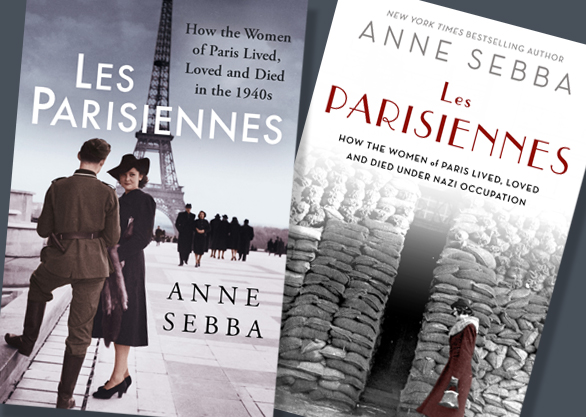
One book two covers

One cover, two books
In July, on Bastille Day, Weidenfeld & Nicolson will publish Les Parisiennes: How the Women of Paris Lived, Loved and Died in the 1940s. In October (in the book trade that’s considered simultaneous) St Martin’s Press in the US will publish Les Parisiennes: How the Women of Paris Lived, Loved and Died under Nazi Occupation.
Spot the differences!

This is not the first time that one of my books has been published simultaneously in the UK and US but I had assumed that since this book had been planned with and commissioned by both publishers together five years ago it would be the same product. Actually it is, exactly the same inside. But both publishers have chosen not only slightly different subtitles (one has the word Nazi while the other points to the fact that I have written about a whole decade) but very different jackets in which to clothe the words. Since I am constantly asked why, I shall try to explain!

The British cover tells a story. In the shadow of the Eiffel Tower (just to make sure you know where this is happening), a slightly wary, elegant Parisienne is chatting up a German officer who, even from the back, looks highly relaxed. His head is sympathetically angled to one side and he has one foot perched on a ledge. What he is saying to her we can only guess at but this cover is so wonderfully evocative that everyone who handles it will want to know what on earth is happening and (I hope) have to buy the book to find out.

The American cover is more subtle but also features an elegant Parisienne, this time she is striding purposefully towards a shelter perhaps, or a doorway protected by sandbags, but into where? This cover too has an air of mystery and needs some explanation. Paris, once defeated in 1940 was declared an ‘Open City’ which was the deal between Vichy and the Nazis which prevented it being attacked by the Germans and saved its most iconic buildings and bridges. But the sandbags were put in place in 1939, when there was huge fear of German bombings, and largely not removed until the Liberation even though it was unlikely that the Allies would bomb civilians when they needed to concentrate their fire power on German and other targets. By 1944 however the Allies considered they had to bomb strategic targets in the vicinity of Paris and there were of course civilian casualties.

When I was first shown the UK cover (yes, authors are consulted!) I was worried the picture was almost too good and therefore must have been staged or even doctored. But, as I should have realised, the truth is always more interesting. It is a genuine photograph by Roger Schall who was given special permission to take pictures in occupied Paris (others were not and if your were caught with a camera there were serious consequences). He had also published during the Occupation several books of views of the monuments of Paris and of France, under the imprints of Verlag Schall, Odé and Kremer with captions in German and obviously directed at a German audience. According to a French museum curator, Catherine Tambrun at the Musée Carnavalet, Schall was probably paid by the Germans to take photographs during the Occupation and the most obvious destination for such photographs would have been the German propaganda magazine Signal. He used his talent to survive. Is it worse than a vegetable seller?

This is another kind of deal, then, and as my book tries to make clear, surviving in Paris was for almost everyone, dependent on doing some kind of deal. After the war this was often punished as collaboration and it was assumed there was a sexual element to many deals. Sometimes there was, but it was rarely as clear cut as that. I have tried over the last few years to understand where the line between survival and collaboration should be drawn and it shifts constantly. I think my two covers lead you enticingly and with great style into that debate.

Buy the book at your local bookshop please! or else through Amazon, Barnes & Noble or IndieBound

What is it about 2016 and anniversaries and why being in Jersey makes me reflect?

The wedding dress worn by Wallis Simpson’s 1st mother -in-law, now restored at a cost of more than £4,000There’s a huge anniversary at the end of this week and everyone in the literary world and beyond is getting very excited about it. Publishers have spent years preparing books on the great man while scholars are falling over themselves to find something new to say, reinterpreting the will or the plays, discovering a greater depth to what he really meant, why he mattered to suffragettes and just how much did he know or invent?

But, excited though I am about Shakespeare, there’s another date this week that’s been exercising me and I am not talking about the Queen’s 90thbirthday. April 24, one day after the big birth and death date, marks thirty years since the death of Wallis Simpson, Duchess of Windsor. I’ve been called by a number of journalists wanting to know how the public perception of That Woman has changed in the thirty years since her death. A German radio station has even prepared an hour long programme on the significance of the Abdication eighty years on…German? Yes, for reasons not difficult to fathom.

To most who ask, I answer that the change came in 2011 with the discovery of 15 unpublished letters which I detailed in my biography of Wallis. But this week I learned another intriguing fact. I am in Jersey to give a talk about Wallis and am told (blushing because I did not know) that Wallis’ first mother-in-law, the mother of Win Spencer, was a Jersey girl! Agnes Lucy Hughes married Earl Winfield Spencer of Chicago in Jersey’s Town Church at St Helier on 10th December 1887. Her magnificent cream silk wedding dress was made by one Madam Henry of New Street, St Helier and was recently restored for about £4,000 by the Jersey Museum for an exhibition which, after it was first shown in Jersey, travelled to America. Now I am intrigued: Agnes was apparently already living in Chicago when she met Earl Winfield Spencer but obviously Jersey mattered enough to her to return there for her wedding. Their unfortunate son, Earl Winfield Spencer Jnr., a handsome pioneer naval aviator, is known to history as the first husband of the infamous Wallis Simpson. But less well known is that another brother, Dumaresq Spencer, died fighting in World War One – a war for which he volunteered and did not have to fight since America initially did not join in the war. I am reminded of him as I walk past Dumaresq Street in Jersey – another clear indication that Jersey was of considerable importance to the Spencers since Dumaresq is one of the oldest names associated with the Island.

Does it matter? Yes actually, it does. I have always known that Win Spencer’s mother was deeply patriotic – so much so that when Dumaresq was killed in World War one she was quoted as saying that if she had another son she would gladly give him to the war effort. I could not understand such exaggerated patriotism. Now I almost do.

But in fact, I was excited to come to Jersey because of its relevance to my forthcoming book, Les Parisiennes, How the Women of Paris Lived, Loved and Died in the 1940’s about women in wartime Paris, when it was occupied by the Germans. I have tried hard not to be judgemental in the book since, after all, how can those of us in Britain, who were not invaded, understand the pressures of a Nazi Occupation? But the Channel Islands of course were occupied. Nowhere could they understand quite as well as here in Jersey and Guernsey what Occupation meant on a daily basis.  So, I can’t wait to return to Jersey and talk about this rather different subject. Well … perhaps not so different. If we hadn’t had the Abdication 80 years ago not only would we not be celebrating such a long reign by our present Queen but, who knows, we might not be celebrating anything much at all. But that is to enter into the ‘what if’ territory from which most sound historians run a mile. But,just occasionally, it’s irresistible as well as amusing to contemplate. And that is why anniversaries matter; they make us stop to think of how we got to where we are.

Good Community Relations

Interfaith Community Relations in Bradford

The Book of Marriage Records Bradford Synagogue

The Book of Marriage Records Bradford Synagogue

In anticipation of this year’s Holocaust Memorial Day and the importance of respecting other communities, I’ve been thinking about a day I spent recently in Bradford where I witnessed a warm coming together of Muslim and Jewish communities. It’s not what you’d expect from reading an average diet of British newspapers or listening to George Galloway, former MP for Bradford West.

I went to visit the synagogue in Bowland Street, Bradford, where my grandmother, the music hall star and Bradford pantomime favourite, Miss Lily Black, was married more than a hundred years ago. The synagogue, founded in Moorish style in 1880 and now a Grade 2 listed building, is desperately in need of funds for repairs if it is to survive. I’d wanted to see it for years but, with the once flourishing community in decline, I knew I could put off my visit no longer. In 2013 the synagogue was saved from closure only thanks to a fund raising effort mounted by the secretary of a nearby mosque, together with the owner of a popular curry house, a local textile magnate and the leader of the local Jewish community, Rudi Leavor. This released much needed funds to repair a leaky roof. It’s a start. After a most delicious lunch at the Sweet Centre curry restaurant, next door to the synagogue, I was reassured by owner Zulficar Ali that he was keeping an eye on the beautiful old building.

Lily was married in Bradford because, barely out of her teens, she had converted to Judaism. She obviously thought it was better to have the ceremony outside London, where she had grown up in a working class haberdasher’s family without much money, left school at 14 and struck out on her own as an artist’s model and actress. In seven years she had made a career for herself and travelled around the country performing, but what did she know of life beyond the stage?

According to Ernest Aris, who went on to become famous as a children’s illustrator and who often drew Lily for several Bradford newspapers, she was “delightful, the most charming Principal Girl this city has seen since Madge Crichton played Cinderella at the Royal. She will make a great hit,” Aris predicted of her while she was starring in Robinson Crusoe at the Prince’s Theatre, “she is sprightly without being vulgar, she has a sweet voice and a personality which would melt even the heart of a Free Church Councillor!”

Ernest Aris clearly had a soft spot for Lily, who was, he added, enshrined in his susceptible heart. However, while performing at Bradford, Lily met and fell in love with my grandfather, Leo Hirshfield from a Birmingham silver making and jewellery family, when he came to try and persuade her to be photographed for a Raphael Tuck postcard. She was only 20 when she accepted his proposal of marriage, converted to Judaism and the couple were married in Bowland Street synagogue on September 25, 1910.

Lily was sufficiently famous for a reporter to attend the wedding. He commented “there were only a few of us present and among the witnesses were Mr and Mrs Henry Cohen of Leeds (Leonora Cohen was the militant suffragette who became famous in 1913 when she flung an iron bar into a jewel box at the Tower of London. She was remanded in prison and went on a hunger strike) and Mr Jacob Moser, Lord Mayor Elect of Bradford. The bride wore a sensible gown of grey silk and was addressed by Rabbi Dr Strauss who told her that “you, my dear bride, have idyllic Ruth of old as your example. You like her have said and verified the touching words whither thou goest, I will go, thy people shall be my people and thy god my god.”

There was a small reception held at the Midland hotel and, immediately upon marriage, Lily gave up performing and rarely talked about her years on the stage. For seven years she had had had a stellar career touring the country and working hard and long hours. She was also in demand as an artist model largely for her spectacular thick and curly reddish gold hair. Now all she wanted was a comfortable and secure home life and she and Leo produced three children, Desmond, who became Lord Hirshfield, a labour peer, Norman who became a Conservative councillor and Mayor, and my mother Joan, who married, in 1946, Major Eric Rubinstein. I was born in 1951 my sister Jane in 1948.
I wish I had asked her more questions as there is so much I now want to know. I am so thrilled at last to have seen the synagogue where her new life began and happy to know that there is new life in the area which is keen to preserve the past. Zulfi Karim, Secretary of Bradford Council of Mosques, who is on the board at the Central Westgate mosque a few hundred metres up the road from the synagogue said: “It makes me proud that we can protect our neighbours and at the same time preserve an important part of Bradford’s cultural heritage.”

Ice Cream for the Soul or Reading for Pleasure

ICE CREAM FOR THE SOUL: ANNE SEBBA ON READING FOR PLEASURE

Council member Anne Sebba reflects on reading for pleasure.

I fell asleep last night with a book in my hands. There were just 40 pages to go until the end but, after a long and tiring day, much as I was desperate to know who lived and who died, I just failed to make it to the finish. Luckily I woke at 5am, before the rest of the household, and raced to the end, sorry it was over but happy to have shared a few days of my life with those heroic yet flawed characters. It was the most gripping and poignant story I have read for ages and urge anyone looking for a beautifully written tale in an original voice, who wants to understand how the heart functions and learn something about twentieth century history along the way (thats all of us, right?) to read Ayelet Gundar-Goshen’s novel, One night, Markovitch although you have to get to the end of the book to find out why it is so named.

It’s hard to convey, in a black and white, matter-of-fact sentence why reading can bring such intense pleasure. Why getting immersed in a good book really does take you to other places, other times. Why, when youre engrossed in a good book, you really cant put it down. Like most things (playing an instrument, running or hiking) the more you do, the better you get and the more you like it but, unlike most things, you dont need any training to start. Reading is not exactly therapy but reading about someone who has experienced the same pain, sorrow, jealousy, elation, fear as you may be experiencing is a wonderfully comforting feeling. We are not, after all, entirely alone in the world.

I realise how lucky I am to have a job (as a writer) where I have to read. But most of what I read for work is factual, has source notes and demands that I take notes as I read. It has its own delights of discovery of course but it simply isnt the same pleasure as reading a novel. I cannot imagine a life where I dont have several books on the go, some on my bedside table, one always in my bag (how often have I been stuck on a train or even in a broken lift?) and others in various places.

But mostly, when we try and tell others, especially children who havent yet caught the bug, about the delights of reading the phrases that creep in have an earnest ring to them: reading is good for you, reading will help you do well at school, etc. That may be true but now at last here is a report that tells you yes, people who read for pleasure do benefit from a huge range of wider outcomes including increased empathy, alleviation or reduction in the symptoms of depression and dementia, as well as an improved sense of wellbeing. People who read for pleasure also have a higher sense of social inclusion, a greater tolerance and awareness of other cultures and lifestyles, possess better communication skills and are better able to access information. But, above all, reading is a pleasure. So why deny yourself?

Go on, have fun – read a book. Its ice cream for the soul.

Get involved

Share the report (commissioned by The Reading Agency) and your responses online using the hashtag #readingforpleasure.

About the author

Are you what you wear?

Luckily the days have long since passed when caring about fashion denoted an airhead. Men and women can now be openly interested in clothes and style and still be considered to have an active brain. Some of the sharpest journalistic brains now report on fashion trends and what that means to the economy as well as the history of clothes and design. Arguably, the pendulum has swung too far the other way as women CEOs and MPs, not just those in media, must be interested in clothes, fashion and looking immaculately soignee, while their male colleagues can still pass muster with a careworn, rumpled look.

Back in the day, I was told as a young Fleet Street journalist that I could not possibly be a serious news reporter and care about clothes or all I’d be given to write about were fashion shows. Wish I’d had the courage to reply then, Course you can, stupid, and at so many levels.

For behind the comment lurks the belief that what we wear is superficial, that it indicates a life devoid of seriousness where books and matters of the mind are concerned. No, actually, we can do both. Ive been thinking a lot about fashion recently for my current book on Women in Paris during the War, Occupation and Beyond; Les Parisiennes. These women cared desperately about what they wore and how they looked, seeing it as their patriotic duty to dress as well as they possibly could in spite of the restrictions. They decided that wearing the most outrageous shoes and hats trimmed with whole fruits, plants, feathers and whatever was an act of defiance to the Germans and showed support for their husbands if they were away fighting or in prisoner of war camps. Okay so its not exactly being part of the resistance if such a thing existed. But it was their way of showing a determination to be just a little bit resistante. By contrast, the British and American women, fighting the same war, saw it as their patriotic duty to be as dowdy as possible, reflecting the harsh times. The different responses provide fascinating historical and cultural insights.

So I couldn’t have been more delighted to be featured for the first time in my life in the fashion pages of The Times recently. My fashion advice? The importance of being comfortable. Well I am the proud owner these days of a freedom pass with no pretensions to being a model. But the truth is I do care about fashion and have a serious interest in matters that concern women, which is sometimes, but not always, an interest in clothes and fashion.

Oh and here is that column…

Are you what you wear ?