
 A talk I gave recently at the October Gallery – The annual Persephone Lecture
I have never thought it a particular advantage to know the person you are writing about. You will have known them at a particular time or in a particular role. Above all, for a child to write about a parent seems to me a recipe for disaster – unless you state from the outset this is a very one sided memoir. Children are often the least useful witnesses a biographer can find. Yet, try as we might to be objective, I think biographers too should plead guilty to subjectivity, to seeing their subject through a particular prism. Perhaps they lived in the same village, studied at the same college but in particular I believe that what we really cannot shed is the age we are at time of writing. However much I think I can imagine a particular emotion, or I am sure that I know what a particular experience must have felt like, I want to take this opportunity – openly and unequivocally – to admit my failure. Only now, having hit 60 myself and living through an age-obsessed time when the secret of eternal youth is promised from many quarters, do I really understand what Enid Bagnold – not exactly a vain woman but one who cared about her looks – meant when she wrote that one of the few counterbalancing factors for the pain of growing old was that, thanks to fading eyesight, she couldn’t really see all those wrinkles and grey hairs that worried her so much in anticipation – (although true to her novelist’s calling, exaggerating to make her point – she is not being wholly truthful even here as of course magnifying mirrors were around in the 1980’s.) But I can now at least understand why she wanted to have a face lift (and how radical was that in the 1970’s) and I admire her honesty and truthfulness about discussing this far more today than I could possibly have 30 years ago.
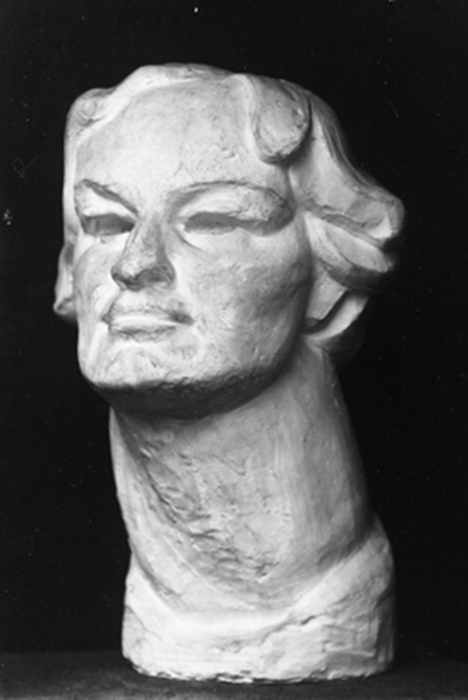
And here she is as Gaudier Brzeska saw her on the eve of WW One
So, I am immensely grateful to Persephone for giving me this second chance to look at Bagnold thirty years on. And of course to Faber Finds for republishing my biography. I’m relieved to say I haven’t found a different person or a different story. But the focus, if I were writing the book today, might be slightly sharper here or hazier there. The emphasis on different aspects of her life might be weightier here and pruned there. Actually I don’t think it would be a better book (I would say that wouldn’t I?) But I now understand in a wholly empathetic way why, in her 60’s and 70’s, she was still burning with ambition to write a successful play. I remember, with shame, a feeling in my 20’s that when I reached 60 I’d be happy to stay at home quietly knitting whereas in fact my desire to travel, to meet people, to achieve and to experience life is not only unabated it is in some ways greater as I am acutely aware of the limited time left and…and I can see why it risks appearing frankly unbecoming in someone of my years just as it did for Enid.
No, I think, or at least hope, that writing the biography of EB in my late 20’s gave me a youthful enthusiasm which suited my subject and gave me a perspective on her young days and early married life I might not have had now. I was rooting for her when the boyfriend didn’t work out (after all it wasn#39;t so far away for me that I could still remember those rejections, sharp longings and early fumblings) but most of all I deeply identified…and I say this fully aware of strictures by that great biographer Richard Holmes that self-identity with one’s subject is the first crime of a biographer…with her passionate desire to have babies and having had them to have more of them and then to be the best mother there had ever been. I understood the passionate and oh so unexpected flood of love when her first golden-haired child arrived – love neither she, nor I, knew we possessed. And then she found it a second time for her equally beautiful son – just as I was to do. My pigeon pair as I learned. The Squire, her truly great novel not just about motherhood but about what she believed it meant to be a woman, springs from that deep well of unconditional love. Enid wanted to go on and on, bringing up such treasures.
 So let’s go back a bit. Who was Enid Bagnold? In her own sparkling and idiosyncratic autobiography (entitled I am tempted to say with no artifice but of course there was artifice aplenty) ‘Enid Bagnold’s autobiography’, published in 1969, she writes that she was driven to explore family history because of her fascination that “sperm had been shot across two centuries to arrive at me”. Such an earthy – and original – simile was typical of her writing (she once described her own prose as ‘beautiful vomit’) but what she is also revealing is an intense fascination with herself. Not unusual for ‘a born writer!’ as she called herself. When I came to research her biography I found all her notebooks and scrapbooks were embellished with directions/ guidance for a putative biographer – me! Pictures of the Franco-Romanian princes, Antoine and Emmanuel Bibesco, for example, princes who had been close friends of Proust, were annotated with helpful comments like ‘this is the brother who committed suicide’ or ‘here we are visiting a church together’!
But Antoine Bibesco, the man she always adored, was never going to marry the plump and rather jolly Miss Enid Bagnold, daughter of Colonel Arthur Bagnold, a man who was as much engineer as soldier, and the former Miss Ethel Alger. They were, as her parents regularly reminded her, gentlefolk, and had been for generations. Enid was constantly testing her parents either by her requests to paint nude models when she studied with Sickert (turned down) or her request to visit the old roué journalist Frank Harris, her editor as well as lover, when he was in Brixton prison – agreed to “because people of breeding do not abandon a friend in need,” her father told her. Read More