
 After 20 years of accumulating detritus on a ridiculously wide range of subjects, I have finally been forced to clear out my study. It’s a grim business that I’ve been postponing for months. This is my private sanctuary, the room of my own where eight books have been written, and it’s the only room where the muse strikes, since I believe a muse is nothing more than concentration, wide reading and being near the laptop at the critical moment. But the builders are arriving tomorrow so no further delay is possible. I have done mini culls before; in fact there is a sort of ritual clearance after each book is finished, putting the mounds of documents and letters into a big plastic box away in the attic hoping no one will ever ask me to search for some obscure reference. But they invariably do and it’s not fun searching on my knees in the dark and dusty attic where wasps make their nest among a different set of rafters every summer. These days there is much less paper generated per book as so much of the information comes through email and is stored on various obsolete hard disks, so why do I feel the necessity to store the old paper version at all? Is there a cut off point, say five years and then shred? But in truth it’s not just the documentation for the books that I keep…I am guilty of keeping hundreds of copies of old magazines (or I did until last week when almost all found their way into the recycling lorry). And I cannot read a newspaper without tearing out pages, half pages or just a column making it impossible for anyone else to read a newspaper if I have got there first. But the trouble with old newspaper articles is that once you have kept them for a few years they acquire a hallowed importance way beyond what is actually in the words or story so then they cannot be thrown away. Mostly these articles go into a pink box labelled: ‘Keep for the novel’. But I have not yet written a novel. Is it because I know real life is always stranger than fiction.The box is staring at me now as I type this. Perhaps this is the moment? Read More
Category Archives: Biography
The American view of Wallis Simpson and my book
Three new reviews this March weekend.
Liesl Schillinger in the New York Times Sunday book review wrote: “Anne Sebba boldly recasts the relationship that was once considered the most romantic love story of the last century as “a tale of gothic darkness with a Faustian pact at its core.”
Sebba’s devourable feast of highly spiced history doesn’t try to hide Wallis’s cayenne bite. Here she retains the epithets customarily attached to her — temptress, social climber, tactless boor, gold digger. But she is granted another that, in light of this substantial new evidence, seems to make her a little more palatable: helpless pawn.
That Woman acquires the propulsive energy of a thriller as it advances through Wallis’s life, picking up speed as she and her royal suitor gain notoriety, then slowing as the couple’s courtship screeches to a halt at their sparsely attended wedding in France.” https://www.nytimes.com/2012/03/11/books/review/that-woman-by-anne-sebba.html?_r=1 (March 10 2012)
Sandra McElwaine in the Washington Times described it as “A delicious new biography… “That Woman” (the name the Queen Mother Elizabeth gave to the dreaded Wallis) is the reason she has returned to center stage in myriad books pegged to the present queen and her upcoming celebration, this meticulously researched, newsy account may well be the sleeper of the lot.” https://www.washingtontimes.com/news/2012/mar/9/book-review-that-woman/ (March 9th 2012)
Linda Lear in the Washington Independent Review of Books wrote: “Sebba’s account, unlike others, succeeds in humanizing Wallis….A strength of Sebba’s work is the emotional and psychological context she provides for the remarkable character traits Wallis demonstrated as an aspiring, flirtatious, acquisitive adult. Sebba makes excellent use of newly unsealed letters from Wallis to Simpson before the 1936 Abdication crisis.” (March 8th 2012)
Archiving for the future
I had an exciting invitation recently; the British Library asked permission to archive my website. Well, who wouldn’t jump at that? I replied with indecent haste. We all want maximum readership for anything we write, worried about our ephemera being lost in the ether. Whenever I give a talk the most FA’d Q is always ‘How will biographers of the future manage without old fashioned letters?’ Admittedly this is not preserving my letters and emails (phew!) But from now on not only will all of you today and for the next week or so read my words but so will future generations. These words which I am typing at haste, imagining no one will ever again see them, will I know now, be preserved in the bowels of the British Library. Or, as the request from the unnamed archivist describes it in its own funny language. ‘We will crawl over your website as soon as we can.’ So my website may not be available to view in the public archive for some time as they archive many thousands of websites and perform quality assurance checks on each instance.

So I cannot claim exclusivity. I am one of almost ten thousand! New sites are added every day and the Web Archiving Programme actively solicits the public to nominate other websites that may be suitable https://www.webarchive.org.uk/ukwa/info/nominate

Radio Gorgeous
The current archive can be viewed at the above site where you will see the enormous variety of websites are preserved …from to Alistair Campbell’s fruity blog to AL Kennedy’s all singing, all dancing site listing her books or her shows as well as the sites of many industrial or commercial airfields in Yorkshire to cyber-geography research projects and South Bradford Methodist church. Do not despair all ye doubters that biographies will never be written in the future, I can hear them proclaiming. As if that weren’t enough to persuade you all that there will still be words to provide content for future books, last week I had the pleasure of being a guest on the wonderful Radio Gorgeous currently housed in an office block in Hammersmith. The host is Josephine Pembroke who after a generous half hour interview told me her plan is to build up an archive of women’s voices women talking about their books, the arts, fashion life or – the day I was there – an astrologer was my fellow guest, and keep them all in that library in the sky as cloudcasts. To learn more. https://www.mixcloud.com/about
New discoveries… after publication
It’s impossible to predict exactly what will emerge on publication of a biography but, rest assured, someone will tell you something you wish you had known before.
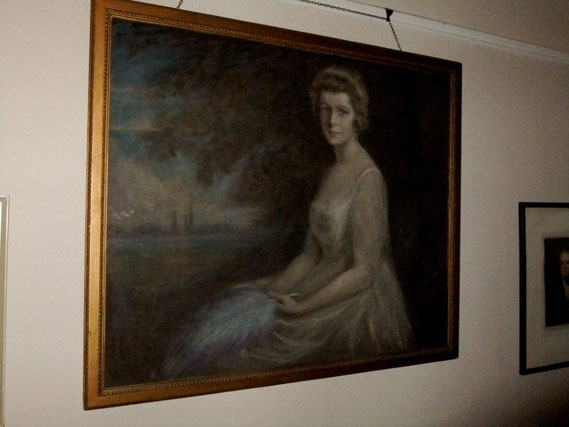
So, the letter that arrived telling me of the existence of a beautiful portrait of one of the key characters in my biography of Wallis Simpson, Mary Kirk, was both a thrill and not exactly a surprise. This week I travelled up to Edinburgh to see it. It is a large (3.5 X 4 ft) pastel, apparently commissioned by her soon-to-be husband, the dashing Frenchman Jacques Raffray and, according to family lore, painted from photographs. It was intended as an engagement present for Mary and Jacques but never sent to America. The artist was Raffray’s aunt ‘Minnie’ Rutherfoord – (Minnie’s sister had married Jacques father)- a professional with a number of works accepted for the Royal Scottish academy exhibitions between 1895-1920. This was to be the last one she showed there in 1920 and bore the rather curious title ‘Down in the Forest’ curious because the background is more of a lake than a forest.
I had always known Mary Kirk was beautiful but the only pictures I could find for my book showed her in her middle years. Still attractive but rather matronly, the inevitable (and fashionable) cigarette dangling from her fingers. This portrait would have been much more striking and perhaps better explained her story. She was a childhood friend of Wallis but travelled in Wallis’s slipstream and manipulated by her. Eventually, when Wallis was looking for someone to occupy husband Ernest while she was off on holiday with the King, Mary and Ernest fell in love. It’s not hard to see why.
The picture, approaching its own centenary, is in good condition although a little faded. Moving or cleaning it might destroy it. The present owners , relatives of the artist, have always known something of the sitter’s history but it was seeing Mary Kirk in C4’s The Secret Letters, the recent documentary based on my book, that stirred them to contact me in the hope of discovering other Kirk relatives .
I have puzzled over why this beautiful portrait was never sent to Baltimore. Perhaps its size or delicacy made that difficult but surely not impossible. Or was it because the marriage between Mary and Jacques soured more quickly than I realised? I doubt this because Mary always wrote in affectionate terms of Jacques, even as she contemplated divorcing him. But who knows? I am certain that, had Mary known of the portrait’s existence once she married Ernest in 1937 and was living in London and especially after a warehouse fire destroyed many of their most precious possessions, she would have wanted it in their house in Upper Phillimore Gardens. Mary died of cancer in 1941 leaving a two year old son who later changed his name and moved abroad. He too never knew anything about the portrait, which has now acquired a life and a story of its own.
Images of Wallis

One of the most frustrating aspects of publishing a book , finally, after years of research is how so many people contact you with anecdotes or information that it’s too late to include. If only they had ‘reached out’ to you sooner. Of course there’s always the paperback!
But occasionally you hear from others toiling in the same muddy ditches and – very occasionally this – there is even scope to combine. Such was my luck this week when I heard from Jessica Palmer, a cut out artist. Jess is a former TV producer who gave it all up to do an MA in Illustration and now specialises in cut-paper and collaged images. Her work features on book covers and in galleries. She is a visiting artist at the V&A, Dulwich Picture Gallery and other museums.
She produces amazing pictures of a wide range of characters but something about Wallis Simpson piqued her interest a little after I had started work on my work. Look at this and you can see why.
The final chapter of my biography on Wallis Simpson, That Woman looks at the reception of Wallis after her death and how plays films books and paintings have changed perceptions
Cecil Beaton, in spite of some less than kind comments in private, turned her into a beauty. Jack Levine was satirically cruel now Jess Palmer. Watch for Madonna’s glamourous version due out later this week.