Blog

Category Archives: Art

Visiting Germany in 2012

Daniel Liebeskind/ Felix Nussbaum house in Osnabruck

Travelling to Germany to give lectures this week, I go first to the pretty medieval town of Osnabrück. My kind hosts show me the sights, starting with the historic town hall of this so called City of Peace where in 1648 a treaty was signed ending the thirty years war. Ah, if only that had been that… The town hall,  with its impressive oil portraits of the signatories and 12th century chandeliers, is a good place to sit and ponder. Osnabrück is also the city where, as recently as 2009, the British had a garrison, the biggest in Europe outside the UK. It is partly the reason for my being invited to give a talk as British army wives decades ago decided that a good way both to cement relations between victor and vanquished and one which would give themselves a reminder of British culture was to form a group called British Decorative and Fine Arts Societies, an offshoot of the better known National Decorative and Fine Arts Societies – or Nadfas.
Just across from the old town hall, in a cobbled square that no doubt comes alive with Christmas markets, I visit the Erich Maria Remarque house. I’d always wondered about that name and what else he had written. In fact he was born in Osnabrück in 1898 as Erich Remark but later took Maria in memory of his mother and changed the K to the more interesting ‘que’ when he became famous. He was extremely handsome and the museum tells the story of Remarque’s complicated private life as well as his work – his friendship with Marlene Dietrich and marriage to Paulette Goddard – and how he fell foul of the Nazis for his damning indictment of war. When they could not reach him they killed his sister instead. After World War 2, he lived in Switzerland, worked on screen plays and many other novels, some of them bestsellers but never quite repeating the success of his early work. All Quiet on the Western Front, which examined the experience of ordinary soldiers, was rejected by numerous publishers until Ullstein took it on. Seeing the much scribbled on hand written manuscript was a reminder of the many different perspectives have created this powerful country.
“Ah yes that happened in former times,” I kept hearing, or “Those were dark days.“ Many ordinary Germans lost homes, possessions, parents and loved ones and it is true that few of the older generation in Germany have not suffered.
But the strongest and most painful reminder of quite how dark those days were came from a visit to the Daniel Liebeskind museum dedicated to that other son of Osnabruck, Felix Nussbaum. Nussbaum, born in 1904 into a prosperous and cultured family, died at Auschwitz  aged 39 in 1944. The Nussbaum Haus is dedicated to his memory and is extraordinary not least for the vast number of Nussbaum paintings that have survived and come back here, including many self- portraits. The building itself , the first Liebeskind building to be finished, shows how the architecture contributes to the experience as it is full of oblique angled walls, sloping windows and angular niches giving a strong sense of lost orientation and withering hope. The growing coldness of the materials – zinc and cement – add to the sense of impending doom for Nussbaum and yet his most powerfully assertive work was arguably created when, after hiding for months in Belgium, he knew he would not survive yet continued painting. Facing the certainty of death he created The Triumph of Death in which he tried to assert that, even when the world is in ruins, a dance of death goes on. He wanted it to be seen as an artistic response and act of liberation and self -assertion amid all the barbarity.

Image taken from WikipediaThe Felix Nussbaum Haus in Osnabrück, Germany. A museum, designed by architect Daniel Libeskind, which houses around 160 paintings by the German-Jewish painter, Felix Nussbaum, who was killed in the Holocaust.”
New discoveries… after publication

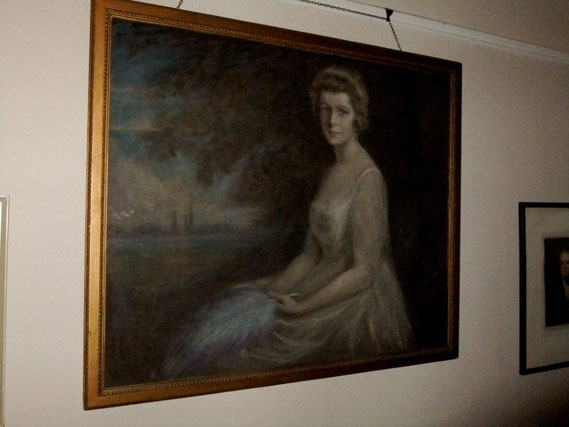
Mary Kirk Raffray picture in Edinburgh

It’s impossible to predict exactly what will emerge on publication of a biography but, rest assured, someone will tell you something you wish you had known before.

So, the letter that arrived telling me of the existence of a beautiful portrait of one of the key characters in my biography of Wallis Simpson, Mary Kirk, was both a thrill and not exactly a surprise. This week I travelled up to Edinburgh to see it.  It is a large (3.5 X 4 ft) pastel,  apparently commissioned by her soon-to-be husband,  the dashing Frenchman Jacques Raffray and, according to family lore, painted from photographs. It was intended as an engagement present for Mary and Jacques but never sent to America. The artist was Raffray’s aunt  ‘Minnie’ Rutherfoord – (Minnie’s sister had married Jacques father)-  a professional with a number of works accepted for the Royal Scottish academy exhibitions between 1895-1920. This was to be the last one she showed there in 1920 and bore the rather curious title ‘Down in the Forest’ curious because the background is more of a lake than a forest.

I had always known Mary Kirk was beautiful but the only pictures I  could find for my book showed her in her middle years.  Still attractive but rather matronly, the inevitable (and fashionable)  cigarette dangling from her fingers. This portrait would have been much more striking and perhaps better explained her story. She was a childhood friend of Wallis but travelled in Wallis’s slipstream and manipulated by her. Eventually, when Wallis was looking for someone to occupy husband Ernest while she was off on holiday with the King,  Mary and Ernest fell in love. It’s not hard to see why.

The picture, approaching its own centenary, is in good condition although a little faded. Moving or cleaning it might destroy it. The present owners , relatives of the artist, have always known something of the sitter’s history but  it was seeing Mary Kirk in C4’s The Secret Letters, the recent documentary based on my book,  that stirred them to contact me in the hope of discovering other Kirk relatives .

I have puzzled over why this beautiful portrait  was never sent to Baltimore. Perhaps its size or delicacy made that difficult but surely not impossible. Or was it because the marriage between Mary and Jacques soured more quickly than I realised?  I doubt this because Mary always wrote in affectionate terms of Jacques, even as she contemplated divorcing him. But who knows? I am certain that,  had Mary known of the portrait’s existence once she married  Ernest in 1937 and was living in London and especially after a warehouse fire destroyed many of their most precious possessions,  she would have wanted it in their house in Upper Phillimore Gardens. Mary  died of cancer in 1941 leaving a two year old son who later changed his name and moved abroad.  He too never knew anything about the portrait,  which has now acquired a life and a story of its own.

Images of Wallis

One of the most frustrating aspects of publishing a book , finally, after years of research is how so many people contact you with anecdotes or information that it’s too late to include. If only they had ‘reached out’ to you sooner. Of course there’s always the paperback!

But occasionally you hear from others toiling in the same muddy ditches and – very occasionally this – there is even scope to combine. Such was my luck this week when I heard from Jessica Palmer, a cut out artist. Jess is a former TV producer who gave it all up to do an MA in Illustration and now specialises in cut-paper and collaged images. Her work features on book covers and in galleries. She is a visiting artist at the V&A, Dulwich Picture Gallery and other museums.

She produces amazing pictures of a wide range of characters but something about Wallis Simpson piqued her interest a little after I had started work on my work. Look at this and you can see why.

The final chapter of my biography on Wallis Simpson, That Woman looks at the reception of Wallis after her death and how plays films books and paintings have changed perceptions

Cecil Beaton, in spite of some less than kind comments in private, turned her into a beauty.  Jack Levine was satirically cruel now Jess Palmer. Watch for Madonna’s glamourous version due out later this week.

Music Never Lets you Down

The gorgeous Valerie Solti said at the opening of this year’s Proms that Music Never Lets You Down…It’s a wonderful phrase I haven’t been able to dismiss from my mind since she said it. I don’t suppose it’s one that either the pianist Joyce Hatto or her husband William Barrington Coupe would agree with.
I have spent days and hours with him and the results, cut down to thirty minutes, can be heard for the next 6 days on i player. I have tried to be fair not soft. It is a minor tragedy in its way for those concerned. Here’s the link:

https://www.bbc.co.uk/iplayer/episode/b00tt6f6/Who_Was_Joyce_Hatto/

Which book? Blogs aren’t book reviews

Deciding what to write about for my first Blog has occupied rather too much of my time for something that is meant to be spontaneous. I assume it will be about a book – what else since I am lucky enough to have publishers send me these, often unasked for, hoping I will Blog about them. But then, rather like not wishing to favour one child against another, the question is ‘which book?’ Blogs aren’t book reviews’, my friend tells me. I was still thinking about this as I drove in the downpour and floods recently to the northern most part of London imaginable that is still London, and there, as soon as I entered Wood Green Library was something facing me demanding that I write about IT. An installation by artist Gitl Wallerstein Braun www.gitlbraun.com called Genesis. I have known Gitl for several years now and my admiration keeps on growing.

Gitl was born in 1950 in Haifa to Holocaust survivors so poor and sick that she was sent to an orphanage. She came to England, had 8 children and, when the last one left, she took hold of her life and sent it hurtling off in a new direction. She wanted to be an artist but first had to learn to speak English. So she went to Wood Green Library www.haringey.gov.uk and started studying. Right from the beginning. Hence the donation to Wood Green library – officially one of the busiest in England. “I wanted to give something back,” she told me.

Aged 50, she enrolled at Central St Martins School of Art www.csm.arts.ac.uk and since graduating in 2006 has worked with enormous dedication and to great critical acclaim. The latest picture is high over the books – I’m not sure what that’s telling me, but I can stare at Gitl’s pictures of textiles for hours and find so many different meanings. They are intensely suggestive and sensual. The inspiration this time for Gitl was finding an old artist’s palette in an auction room but, as I look at the hole for the artist’s thumb I see another eye – or is it an abyss.? All Gitl’s art has a story. Her story. But I look at this and think of many stories. It’s on permanent display so go there and stop for moment to contemplate a masterpiece. She is such an inspiration to women, to immigrants, to artists and just to anyone who wants to learn and understand and think.