Blog

Walking Between the Raindrops

The most important moments happen in kitchens, says David Grossman the Israeli novelist in London briefly this week explaining why he wanted a mother as the main protagonist of his new book. I needed someone who would NOT collaborate with the machinery of government nor with warfare, he said. A man would not run away from the notifiers but a woman could and does. Listening to him talk about his characters in The End of the Land at Friend’ House on Thursday night, and then later Henrietta Foster’s film on Newsnight – (well worth watching on iplayer)– I could feel his own raw agony and how, as he said, war radiates into the bubble of family destroying whatever it finds there.

So why a mother not a father? Grossman says the appeal of being a novelist is to become the character he’s creating. I love the idea of being invaded by so many people who are different from me. Tragically Ora was not so different from him. His own son, Uri, was killed in the Lebanon War in 2006. Mother or Father, war anywhere is the most brutalising form of existence contrary to every form of nurturing creativity that a mother and a father can make together. How long can anyone in Israel keep walking between the raindrops without getting splattered, Mother or Father? Grossman has not yet embraced despair but he is not exactly full of hope either.

Which book? Blogs aren’t book reviews

Deciding what to write about for my first Blog has occupied rather too much of my time for something that is meant to be spontaneous. I assume it will be about a book – what else since I am lucky enough to have publishers send me these, often unasked for, hoping I will Blog about them. But then, rather like not wishing to favour one child against another, the question is ‘which book?’ Blogs aren’t book reviews’, my friend tells me. I was still thinking about this as I drove in the downpour and floods recently to the northern most part of London imaginable that is still London, and there, as soon as I entered Wood Green Library was something facing me demanding that I write about IT. An installation by artist Gitl Wallerstein Braun www.gitlbraun.com called Genesis. I have known Gitl for several years now and my admiration keeps on growing.

Gitl was born in 1950 in Haifa to Holocaust survivors so poor and sick that she was sent to an orphanage. She came to England, had 8 children and, when the last one left, she took hold of her life and sent it hurtling off in a new direction. She wanted to be an artist but first had to learn to speak English. So she went to Wood Green Library www.haringey.gov.uk and started studying. Right from the beginning. Hence the donation to Wood Green library – officially one of the busiest in England. “I wanted to give something back,” she told me.

Aged 50, she enrolled at Central St Martins School of Art www.csm.arts.ac.uk and since graduating in 2006 has worked with enormous dedication and to great critical acclaim. The latest picture is high over the books – I’m not sure what that’s telling me, but I can stare at Gitl’s pictures of textiles for hours and find so many different meanings. They are intensely suggestive and sensual. The inspiration this time for Gitl was finding an old artist’s palette in an auction room but, as I look at the hole for the artist’s thumb I see another eye – or is it an abyss.? All Gitl’s art has a story. Her story. But I look at this and think of many stories. It’s on permanent display so go there and stop for moment to contemplate a masterpiece. She is such an inspiration to women, to immigrants, to artists and just to anyone who wants to learn and understand and think.

Artful lessons in power dressing

Evening Standard: Feb 18 2010

Artful lessons in power dressing

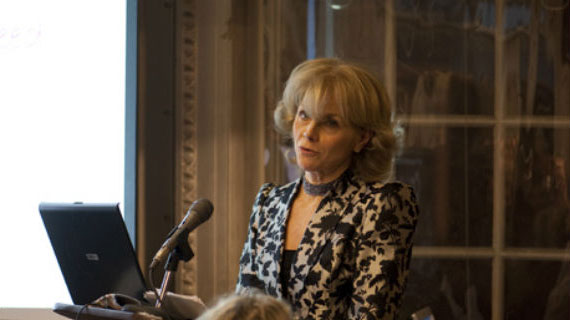
Godolphin and Latymer School for Girls in Hammersmith, hosting its first Arts Festival next week, has men talking for three out of four evenings Andrew Marr, Chris Patten and William Boyd. But on Tuesday 23rd, Francine Stock and Anne Sebba, both mothers with daughters at the school, will be discussing how women use power and influence.

Sebba, biographer of Laura Ashley, Mother Teresa, Jennie Churchill now researching Wallis Simpson, thinks women excel at manipulating behind the throne. To prove her point she will wear killer high heels and a jacket by Alexander McQueen, the late fashion designer whose clothes “made women feel powerful”. Hmmm … what sort of lesson is that?

Pursuit of Beauty by Remote Control

Review by Peter Stanford, Independent on Sunday, August 15 2004

We are a society addicted to home improvements. With a sheet of MDF and a few relics rescued from the back of the garage, we have all been encouraged to believe by Lawrence Llewelyn-Bowen and his acolytes that we can create our own Petit Trianon in Penge. William Bankes worked on a larger scale, but essentially shared the same dream.

Even before the death at 21 in 1806 of his elder brother, Henry, Bankes had been planning a makeover for Kingston Lacy, the family seat in Dorset. But as son and heir to the estate – as well as to Soughton Hall, a slice of north Wales owned by a great uncle – he quickly developed his own grand designs for changing both rooms and facades.

However, his remorseless pursuit of an eclectic artistic and architectural vision was interrupted by a moment of madness with a guardsman in some bushes in London¹s Green Park in 1841. Gay sex at that time carried the death penalty and Bankes was forced to flee into exile, pursued by a vindictive (Tory) government which declared him an outlaw and forced him to sign over all his properties to a younger brother to prevent them being seized by the state. For the last 15 years of his life, living in Venice, Bankes had to complete the rebuilding of Kingston Lacy by remote control, never seeing with his own eyes the achievement of his vision.

Anne Sebba tells this tale of talent and tragedy with great aplomb, producing in the process a wonderful hybrid of a book that is part biography, part tear-jerker, part lesson in art and architectural history, and part exquisite guide book to what is now one of the finest properties in the National Trust’s portfolio. She even manages to weave in some insights into the psychological make-up of the great collector of artefacts, contrasting Bankes¹s need for emotional support in an unfriendly world¹ with the motivation of history¹s other hoarders.

She is helped enormously by her subject¹s knack for rubbing shoulders with a succession of figures who have enjoyed a more enduring fame. Looming largest in Bankes¹ life was Lord Byron. They were close as students at Cambridge where their relationship caused such jealousy among Byron’s circle that they accused Bankes of attaching himself to Byron’s coronet. There was certainly an on-going rivalry between the two men, one flamboyant, the other arrogant, but both single-minded. Yet there was also an enduring friendship and respect. They both proposed simultaneously to the same woman – Annabella Milbanke. She said yes – disastrously – to Byron and no to Bankes who she rightly suspected as being half-hearted in his suit.

Sebba shows her mettle as a biographer (her previous subjects have included Enid Bagnold, Laura Ashley and Mother Teresa) by her handling of Bankes¹ sexuality. It would have been all too easy to make him a gay martyr and use the appalling nineteenth century prejudice he suffered as a stick to beat those who today still believe homophobia has any place in a civilized society. But that would have unbalanced the text. Equally she could have indulged the habitual prurience of contemporary readers with speculation about what exactly went on in the bushes in Green Park – or in the toilets behind Saint Margaret¹s Church, Westminster, where in 1833 Bankes was arrested with another soldier, but on that occasion eventually acquitted.

Instead Sebba conveys the facts, the context and the consequences with a benign detachment. Bankes, she shows, was bisexual. As well as his failed proposal to Annabella, he had a notorious affair with the Countess of Buckinghamshire. And Sebba is not afraid to explore ideas that for some might seem politically incorrect – like the suggestion that an artistic temperament and sexual orientation could be linked.

But this is absolutely not a psychologically intense portrait. Rather it hugely enjoys the wonderful detail of Bankes¹ life – his youthful shopping sprees in Spain buying Zurbarans, Murillos and Velasquezes for what became the ornate Spanish Picture Room as Kingston Lacy; his pioneering role in nineteenth century Egyptology and his jaunts around the Near East where he clashed with another formidable traveller, Lady Hester Stanhope; and his largely failed and often comical attempts as an MP to make a name for himself as an orator on the floor of the Commons.

His monument, however, is Kingston Lacy, preserved in aspic by successive generations of the Bankes family before being handed with its contents to the National Trust in 1981. The story of his work with Charles Barry, architect of the Houses of Parliament, to revive earlier plans that Inigo Jones had drawn up for the property is fascinating. In later years he would send off from Venice plans and drawings for a house he hadn¹t seen in years (and didn’t own) but over which he insisted on maintaining the most exacting control.

You end up yearning for there to be a happy ending. There were, Sebba recounts, local stories that he used to sail into Studland Bay at night and wander round his house, leaving before morning, but try as she might she cannot make them stand up to historical scrutiny. Perhaps we just have to let our imagination run away with us. That was after all the genius of William Bankes.

Meet Mr Makeover

By Frances Spalding, Daily Mail, 30 July 2004

The portrait on the cover of this book is that of a sensualist. William Bankes, who had reddish gold hair, pale skin dark eyes and a rosebud mouth, was by all accounts a charmer. He was also a prodigious traveller who rattled with good talk.

Dinner parties began and ended with his conversation. ‘His voice’ a fellow aristocrat noted, ‘is painfully unpleasant but he is full of knowledge and originality.’ When he visited his friend Byron in Venice, the two men, gossipy and erudite, happily roamed the city together. The character uncovered in this brisk, authoritative and readily engaging book invites both admiration and pity. Bankes’ great achievement was Kingston Lacy in Dorset, the ancestral home he inherited n 1834 after the death of his father. Henry Bankes, a longstanding Tory MP who had directed government expenditure on the Napoleonic Wars.Few of the extensions and improvements done to the house in Henry’s day had met with his son’s approval. Once he came into his inheritance, William with his sensitive eye and full wallet, embarked on numerous alterations. He had already amassed a rare collection of Egyptian and European art. But in order to house it, Kingston Lacy had to become an Italian Palazzo.

To this end, Bankes imported cratftsmanship of the highest order. One gilt and coffered ceiling came from a Venetian Palace. His marble staircase he claimed had no equal in England and scarcely could be bettered in Italy. And so it continued as he lavished enormous attention on every detail.

But in the midst of this great project just at a time when he had become widely regarded as an arbiter of taste (and had even been invited to advise a Select Committee on the decoration of the new Houses of Parliament) Bankes was arrested for “homosexusalism”.

It was not the first time. Eight years previously he had been caught in a public convenience with a Coldstream Guardsmen. Because he was then an MP news of his arrest spread fast and 2,000 strong mob howling for justice gathered outside the police station where he was being held.

Sodomy was at that time a capital offence. The same year, 1833, a Captain Henry Nicholls had been hanged for it, while his companion, threatened with a similar conviction had committed suicide.

If good testimonials were obtained it was usual for a gentleman to be acquitted on his first charge of meeting together for unnatural purposes. Bankes was duly found not guilty.
But when eight years later, aged 55, he was caught in Green Park with a soldier from the foot guards he was in danger of losing his life. Anne Sebba is marvellously sure footed in her grasp of this tale. She has previously written biographies of a writer, a saint and a businesswoman – Enid Bagnold, Mother Teresa and Laura Ashley. Her journalistic skills enable her to extract information in a way that is both lively and illuminating.

Bankes’ antiquarian enthusiasm and legal problems are made transparently clear in this absorbing account of a most unusual life, the last part of which was spent in exile as an outlaw.
Before fleeing the country, Bankes went to see the family solicitor. He learnt that if the treasury outlawed him all the property he possessed in Britain would become forfeit to the crown.
He therefore followed legal advice and assigned to his two brothers and a nephew all that he owned, including the freehold and leaseholds of his estate Kingston lacy on which he had devoted the greater part of his career was no longer his.

But it remained his consuming passion. For the last fifteen years of his life he lived mostly in Venice searching out the best craftsmen and the finest materials.
Crateloads of marble were sent home as well as lengthy instructions as to how doorways were to be fitted or leather wall coverings treated.

He dwelt on the relationship between the house and the garden and advised on the planting, requesting that the border below the terrace be filled with violets. “Any flower that rises higher above the ground will distort the architecture, ” he wrote. It has been assumed that he never saw the house again for had he returned to England he would have been swiftly arrested.

But Sebba has found evidence which, though slight, makes it probable that he crossed the channel, landed one night on the beach where he had played as a boy and was hastily transported to Kingston Lacy for a quick inspection.

What remains certain is that the house still boasts his dream of beauty. It continued to belong to the Bankes family until 1981 when it was bequeathed to the National Trust.
Five years later it opened to the public. For many visitors it is the staircase and the Golden Room or Spanish Room which best convey the richness which, in Bankes’ opinion, was the touchstone of decorative success.