
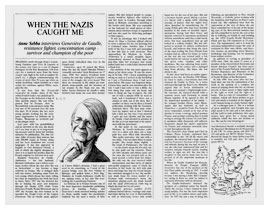
 Anne Sebba interviews Genevieve de Gaulle, resistance fighter, concentration camp survivor and champion of the poor
for The Spectator.
Heading north through Paris’s Luxembourg Gardens, past Yves St Laurent at the corner, you come to a row of elegant boutiques on the Rue Bonaparte. Lift your eyes for a moment away from the haute couture and, high in the wall at number 68, you’ll see a plaque commemorating the events of more than 50 years ago when an untidy bookshop, which doubled as a vital centre for resistance against Hitler, occupied the site.
It was here that the 23-year-old Genevieve de Gaulle, niece of the then exiled French leader, was picked up by the Gestapo as she delivered a bag of false identity papers. She was transported first to Fresnes, then to Ravensbruck concentration camp. She was one of 80 arrested over the next few days, 50 of whom, like her, were young people working for the resistance organisation La Defense de la France. ‘Beaucoup ne revinrent pas’ as the plaque states.
Last year, with ten grandchildren and an eleventh on the way, she decided it was time to give in to long-standing pressure and set down her wartime memoirs for publication. The slim volume, fuller of poetry than rancour, has sold 200,000 copies in France alone and has been translated into several languages. It has just appeared in English as God Remained Outside, a title of which she slightly disapproves since it is so much less positive than the French original, La Traversee de la nuit.
Madame Genevieve de Gaulle Anthonioz – her late husband, Bernard Anthonioz, was a fellow resistance worker whom she met after the war in Switzerland – has become a huge celebrity in France. She is deluged daily with fan letters, including some from the very young, which please her most, telling her what an inspiration her book has been to them. Since 19-57 she has devoted her life to helping the poor and homeless through the charity ATD (Aide Toute 136tresse) Fourth World Movement and in 1997 she became the first woman to be awarded the Grand Cross of the Legion d’honneur. The de Gaulle name appears more firmly embedded than ever in the French soul.
Genevieve, aged 19, joined the Resistance the day she heard Marshal Petain’s ‘cowardly surrender’ from Bordeaux on 17 June, 1940. Her uncle’s broadcast from London the next day, calling for a continuation of the struggle, she never heard. ‘But there are moments in life which are completely unacceptable and the invasion of our country by the Nazis was one. My father Xavier [General de Gaulle’s older brother] had made me read Mein Kampf, so I knew Hitler’s doctrine. I had a great need to do something, so I went to the nearest bridge, over the river Vilaine in Brittany, and pulled down a Nazi flag,’ Madame de Gaulle-Anthonioz recalls for me, sipping water, in her attic flat overlooking the Luxembourg Gardens.
La Defense de la France became one of the most important clandestine publishing presses in wartime France. and Genevieve’s work involved writing articles for them, usually under the pseudonym Galliard, but she used a variety of false names. She also helped people to escape, mostly would-be fighters who wished to join her uncle in London, through either Spain or Brittany, sometimes travelling to the border with them. She was constantly on the look-out for small pieces of information about German troops or equipment and was also used for delivering packages or false papers.
‘It was an advantage that I looked only about 16. Once a German official offered to carry a suitcase for me, not knowing that it contained arms. Another time I took hold of the boy I was with and pretended to kiss him just to look innocent.’ Now approaching 80, Madame de GaulleAnthonioz is a small, sprightly figure, immaculately dressed in black skirt and pale-blue shirt, her steel-grey hair neatly pulled back into a coiled plait fastened with a black bow. Her memory of the war years appears as sharp as her dress sense. ‘it was the morning of 20 July, 1943. 1 knew something was wrong as soon as I arrived at the bookshop as I saw a Frenchman there I had never seen before. His name was Inspector Bony, I learnt later, and he was executed after the war. I said I had come to buy a Bible, the first thing that came into my head, and tried to dump my bag of papers. He told me to wait a minute while he went to look, and I wondered if there was a chance to slide out of the door. But I couldn’t as there was by then a French policeman, working with the Germans, stationed there. The first man examined my papers and at first I showed him a false set, but once I was arrested I gave my true identity and the name de Gaulle. I had decided in advance to do this as it was important to be associated with the movement.’
At this point in our conversation Madame de Gaulle-Anthonioz walks over to a chest and takes out a large gold box once filled with chocolates. ‘Mes petits souvenirs,’ she says with a wry smile. ‘I do not show these to many people.’ Her hands shake slightly, the result of Parkinson’s, she tells me – as she slowly opens the box and, one by one, pulls out the contents. There are false identity and ration cards, not the ones she was arrested with as she used several; a letter from her father, the only one she ever received while incarcerated; and then items of almost unbearable poignancy, some of which she describes in her book: the doll with pink dress and beige lace that her friend Jacqueline somehow smuggled to her, the needlecase made from the stolen leather of a German tank commander’s beret, the miniature playing-cards she made herself and the small embroidered cloth bag in which she kept her bread ration.
Genevieve, prisoner number 27,372, endured forced labour, beatings and semistarvation during her year in Ravensbruck, as well as witnessing scenes that would haunt her for the rest of her days. She saw a German female guard slitting a prisoner’s throat with a spade while shouting screams of hatred. And her nights were often disturbed by remembering the 75 young Polish girls who had been horribly maimed in the name of scientific experimentation, having had their bones and muscles removed in operations performed without anaesthesia until they could barely move, but were nonetheless tied up and locked in a solitary bunker. She was subjected to periods of solitary confinement herself. and believes that being the niece of the man leading the Free French from London had no effect for better or worse on the way she was treated until. a few weeks before her release in April 1945, she was given some vitamins and other medicines. She was suffering from scurvy, ulcerations of the cornea and a damaged lung from pleurisy. She knew she was about to die.
In fact, there had been an earlier opportunity to free her. In October 1944 Himmter tried to make a last-minute deal with General de Gaulle in Paris. In a letter delivered through the Red Cross, Himmler argued that as Soviet domination of Europe now seemed a frighteningly possible outcome, the General should make a separate peace with Germany to attack Russia together. If he agreed to this, all the imprisoned members of his family his younger brother Pierre, sister MarieAgnes and her husband, as well as Genevieve – would be freed. The General never responded, certain as he was of his destiny to create a strong, unified postwar France, and perhaps realising that it would wrong to arrange the release of a few family members while thousands still suffered. Genevieve shared her uncle’s aspirations for France and remained extremely close to him throughout his life.
The General’s close friend and Chef de Cabinet, Pierre Lefranc, explained their relationship to me: ‘Of all his nieces and nephews, the General had a huge admiration for Genevieve because of her courage and attitude during the war and, in turn, it was she who best understood him and his inclusive attitude towards society, tending neither to right nor left. She was like a daughter to him and he made sure he was present at all the important moments in her life.’
When de Gaulle founded his Rassemblement du Peuple Francais (RPF) Genevieve was one of the speakers at the first Paris public meeting in t947. ‘I could not address the Strasbourg meeting because I was having a baby. But I remember saying in Paris we must be united to represent all France with no divisions.’
De Gaulle-Anthonioz shunned the prospect of a political career for herself. ‘Quite the reverse, I have wanted to transcend politics. For me the most important goal in life is to combat misery and exclusion.’ In 1957 she saw a way of doing this following an introduction to Nre Joseph Wresinski, a Catholic priest working with the homeless and hopeless in Paris’s cardboard city. She explained later how the expressions in the eyes of those she saw there reminded her so keenly of the haunting eyes of the Ravensbruck inmates that she felt compelled to devote the rest of her life to lobbying on behalf of, and building up, the AtD Fourth World Movement, which now has 330 volunteers in 23 countries. The organisation’s aim is to help the extremely marginalised escape the cycle of exclusion by their own efforts, and therefore focuses on providing street libraries, workshops and training, not on handouts from welfare centres.
In addition to serving as president of ATD since 1964, she spent 11 years as a member of the Government Economic and Social Advisory Council, has been president of the French National Association of Former Deportees and Prisoners of the Resistance, and director of the Committee of Social Welfare of the Resistance.
In July 1998, four years after her husband died, she saw the culmination of her work in the passing of a complex law aimed at helping those who live in extreme poverty to have access to basic rights such as the right to work and the right to a home. ‘This is a law of “orientation”,’ she explains, ‘which will direct politics in general and which is founded on the dignity of every human being as a basic human right.’
As a colleague puts it, ‘She is a woman of great simplicity and strength who says what needs to be said and is not afraid to tell the truth to male politicians. Her experiences have given her a strong moral authority which she does not hesitate to use. She can be very intransigent.’