
‘How can one possibly explain the role of music in a death camp?’ I am often asked and, of course, it defies rational explanation. But the so-called Women’s Orchestra of Auschwitz – they referred to themselves as a Girls’ Band – was a perversion of music, music as a deception intended to fool any visitors that this was a military work camp whereas in fact the music was a further tool of Nazi torture. There were other musical ensembles in Auschwitz (and some other camps) all used primarily to force those prisoners sent out to work in the fields or subcamps to march in lock step as an aide to counting them on the way out and again when they returned at the end of the day. They had to endure such jaunty tunes as Schubert’s Marche Militaire and, however exhausted they felt, if they failed to march in time, risked a fierce kick, which might finish them off.
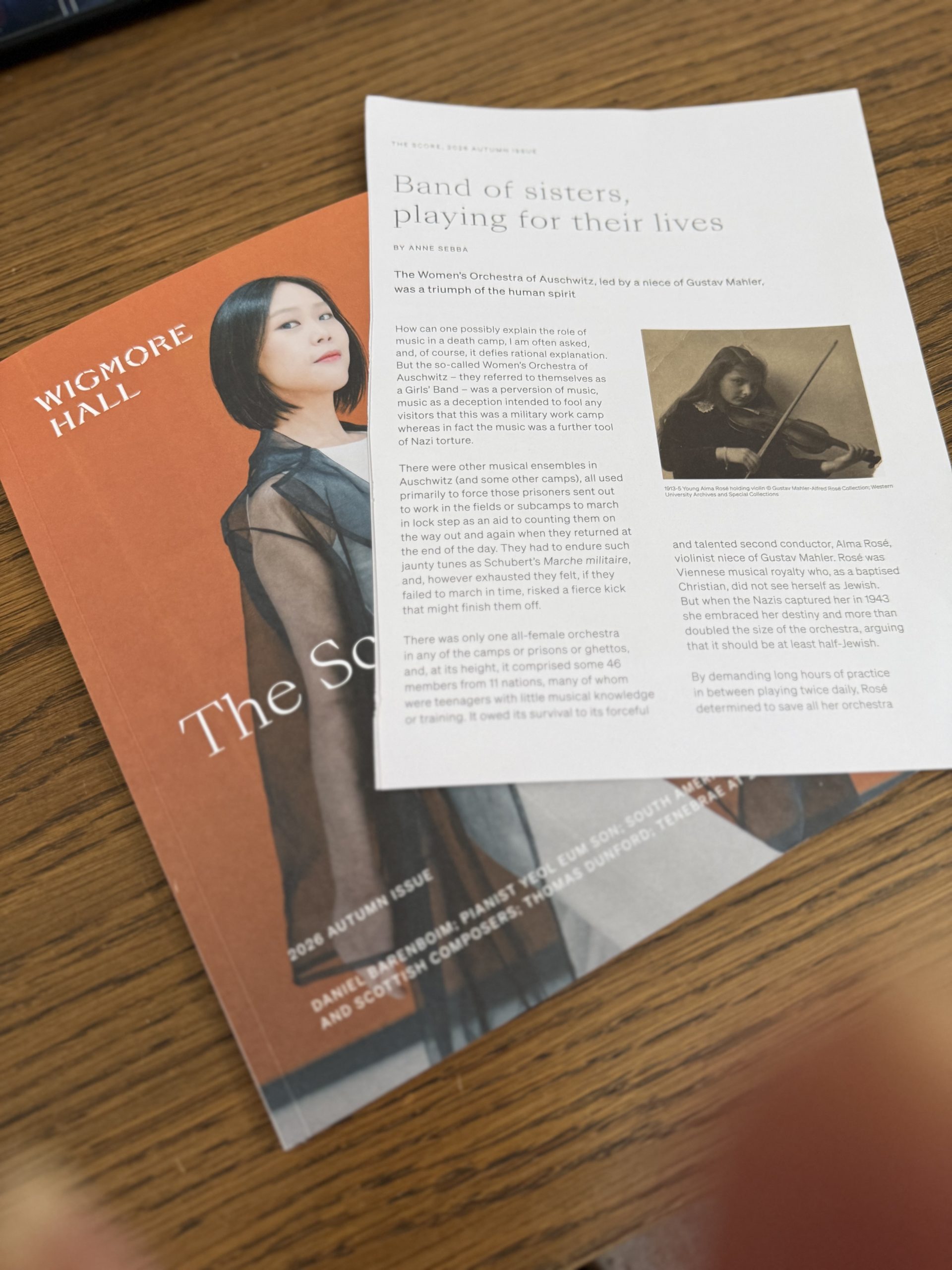
There was only one all-female orchestra in any of the camps or prisons or ghettos and, at its height, it comprised some 46 members from eleven nations many of whom were teenagers with little musical knowledge or training. It owed its survival to its forceful and talented second conductor, Alma Rosé, violinist niece of Gustav Mahler. Rosé was Viennese musical royalty who, as a baptised Christian, did not see herself as Jewish. But when the Nazis captured her in 1943 she embraced her destiny and more than doubled the size of the orchestra arguing that it should be at least half Jewish. By demanding long hours of practice in between playing twice daily she determined to save all her orchestra members from being gassed. But she could not save herself and after eight months pushing her girls to their limits, fell prey to food poisoning and died on 4 April 1944 aged 37. Shortly after this the orchestra floundered and by the end of October 1944, in the face of the Soviet approach, the Nazis started to evacuate Auschwitz and destroy all evidence of their egregious crimes. They sent the Jewish half of the band to Bergen-Belsen.
I discovered this story a decade or so ago as I started researching the history of the Belsen camp, convinced that the liberation on 15 April 1945 was a triumph of the British army not adequately recognised. I was vaguely aware that my own father, a tank commander in the British army, had been at Belsen around this time, and yet, like many of his generation, was always reluctant to talk about it while I, foolishly, had failed to press him.
Two documents in particular drew me into the story of the women’s orchestra. The first was a striking playbill for a concert at Belsen on 24 May 1945, just one month after liberation. Organised by Red Cross nurse Margaret Montgomery, sister-in-law of the British Field Marshall, the concert featured mostly singers, several of whose names I recognised from the Sunday afternoon concerts at Auschwitz. It included few instrumentalists, because at first there were no instruments at Belsen.
At the same time I discovered my father’s war diary which revealed that also on 24 May 1945 he was organising to send in the Churchill flamethrower tanks to destroy the lice ridden huts of Belsen.
I could not ignore the synchronicity of these two pieces of information and although I am convinced my father must have attended that concert, I will never know.
The Nazi aim was ultimately to destroy Jewish lives and Jewish culture but, until the point of death all those forced labourers – and the musicians were forced labourers just like the others – they tried to destroy their dignity and their humanity through cruelty and starvation, by shaving their heads and then tattooing a number on their forearms intended to replace names. My aim in writing a book about the Women’s Orchestra was to discover as many names as possible of those who had been forced to play in the marching band and restore their humanity by fleshing out as much as I could of their story.
It was my great privilege to talk to two women who had played in the orchestra; Anita Lasker, at 101 still alive at time of writing, a talented cellist and Hilde Grunbaum, who I met aged 99 at her home in Israel, a violinist and later arranger and the first Jewish girl in the orchestra.
I met other prisoners who had been forced to listen to the music and I watched hours of vivid testimony much of it collected by the Shoah Foundation set up by Steven Spielberg in the wake of his film Schindler’s List.
Often these women displayed amazing calm as they recounted the cruelty of their Nazi overseers fifty or so years later, yet many wept when they reported the fate of their families who arrived with them in the camp and explained as best they could about selection on the ramp. Those deemed young and fit enough to work were brought into the camp and assigned a kommando. This might be the kitchen, laundry or warehouse known as Kanada, or from 1943 onwards a musical ensemble. Most of the instruments for this came from Kanada because deportees having been told to bring their most precious possessions, might choose to bring an instrument if small enough. The absurdity of the musical enterprise reached its apogee when a Jewish girl from Salonika, in danger of losing her place in the orchestra after a spell in the infirmary, was able to stay if she learned to play a new instrument, the double bass. To this end the Nazis not only sent over a musician from the men’s camp to teach her but somehow requisitioned a double bass.
As Anita often said: “Who can understand these people? One minute they want Schumann’s Träumerei, and the next they are putting people in the fire,” As she had to make clear subsequently, an appreciation of musical culture did not, sadly, prevent cruelty.
I have struggled to answer one other question frequently posed: were these women saved by music? Yes, to the extent that Alma Rosé forced them to concentrate on playing well enough to please their Nazi masters and not dwell on the misery surrounding them. But no, they were not saved by being able to immerse themselves in the beauty of music such as you will hear on 26 January when Natalie Clein performs Bloch’s Three Scenes from Jewish Life plus Méditation Hébraïque as part of a Holocaust Memorial Day event (including a talk from me) at Wigmore Hall.
After the War, many of them could never again enjoy music.
Why does this story matter? I believe that female courage in wartime and these women’s determination to survive such brutality demands to be recognised. They did not always share their scraps of food with each other but, when they needed to, they overlooked their differences and played their hearts out together in what is ultimately a triumph of the human spirit impossible for the rest of us to imagine.
Anne Sebba is the author of The Women’s Orchestra of Auschwitz A story of Survival Weidenfeld & Nicolson isbn 978-1399610759