
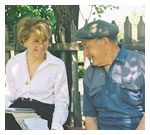
 Grigory Rodin, a survivor of the 1941 Babi Yar massacre on September 29- 30, 1941 when some 33,000 Jews were murdered in two days of shooting, was born in Kiev and now lives in a one room flat in Berdyansk on the Sea of Azov, Southern Ukraine with his wife.
As told to Anne Sebba
” Those cries. That’s what I’ll remember all my life. Mothers wailing, holding up their babies to the heavens and crying: ‘Hashem Wo bist du ?’ (God, where are you? in Yiddish) I still have nightmares about this scene. It’s in front of my eyes right now. I am re-living it. I will never ever forget it.
I didn’t cry then. I was barely 12 years old. I was in shock. I didn’t understand what was happening or where we were going. I was tired, dirty and exhausted. I didn’t feel like a human being even. But the mothers, the ones holding up their arms, shaking and crying, I suppose they just guessed. I thought we were going to the woods at Babi Yar and would then be taken to a ghetto. But I didn’t really think about the outcome. I was looking for my parents among the thousands of people in the lines.
I was born in Kiev in 1929. My mother and father were both deaf so I was brought up by my grandmother. I had nine brothers and sisters and we were a big, united family.
But my older brothers went off to the front to fight and in August 1941, when we heard the Nazis were approaching Kiev, my sister and I tried to escape. But the train we were on was bombed and we got separated.
I spent the next month wandering through villages, sleeping by the roadside, scrounging food. I tried not to think about fear but I was very frightened and at the end of September I came home.
My neighbours told me that my parents were in the big crowd of Jews which was assembling in the city centre. The Germans had put up a notice ordering all Jews to report there shortly after they had captured Kiev. As I tried to search for them I was grabbed by a policeman and beaten into line.
We walked through the streets and out into the countryside. As we approached the Babi Yar ravine, about 12 kms northwest of Kiev, we started to hear the sound of guns and automatic fire. But there was no escape. The Nazis had sticks and snarling dogs so you couldn’t stray.
When I finally reached the pit I was so afraid I just remember feeling a terrible pain in my face where I had been shot. Luckily the bullet only grazed my cheek – there is still the scar – and then I lost consciousness and fell in.
When I woke I felt bodies all around, under and on top of me. I was covered with blood and I was so frightened I screamed. But guards were patrolling so I realised I had to keep quiet. I crawled out and reached a nearby cemetery where I hid in a tomb.
I had no plan, no idea what to do. I just wanted to go home. A family friend, a Russian, washed me, gave me some new clothes and a food package but told me I had to leave or I would be killed.
So, in October, 1941 I finally left Kiev and spent the rest of the year living rough, just surviving. Eventually I arrived in Stalingrad, where I found work in a factory. I stayed there until almost the end of the war.
But I was determined to get back to Kiev and learn what happened to my parents. I started walking again, or riding free on the roofs of trains, and soon ended up in a police station begging to be arrested as I was so desperate for food and a bed. I was taken to a hostel for the homeless and given a job in another factory. It was here I met my wife, Leah.
I wasn’t brave. I was just a silly child. But there was a time, right after the war when I felt too tired to live without a home any more. I tried to jump from a bridge into a river but an elderly Russian came past and grabbed me. He said: God gave you life, how can you decide to end that life? He took me to his house and explained that his own 3 sons had been killed and he wanted to treat me as his own. He gave me food and hope and after that I was never able to contemplate suicide. But it is still very hard to live with these memories, which keep re- surfacing.
My wife suffers from high blood pressure and cannot go out and I’ve had three heart attacks. We manage because a local Jewish charity brings us daily hot meals and gives us medicines.
I used to go regularly to Babi Yar, even though I can no longer recognise the spot where I was shot. I was not looking for answers but it is the site of my parents’ graves and I feel it is mine too. Now I am nearly 80 and not well enough to travel. But something kept pushing me there. I feel connected to Babi Yar for ever.”
For further information contact www.worldjewishrelief.org.uk