
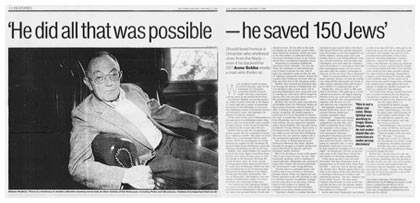
 A retired Israeli historian fighting for the reputation of a Ukrainian Nationalist church leader who had a close bond with the Nazis? Sounds unlikely.
But Emeritus Professor Shimon Redlich, in London this month, feels passionately that this is not just a question of examining the record of one individual but a matter of historical accuracy, historical “truth” and the dangers of collective memory.
Redlich began researching the story of Metropolitan Andrei Sheptyts’kyi, Head of the Greek Catholic (Uniatic) Church, some twenty years ago when he was a visiting scholar at the Harvard Ukrainian Research Institute (HURI). Later, he wrote a partly autobiographical book describing pre-war life in his own home town of Brzezany, where he lived until he was ten, aiming to show the interdependence of Polish, Jewish and Ukrainian communities.* The role played by Sheptyts’kyi, who risked his own life during World War 2 to save some one hundred and fifty Jews, including two families of Lwow Rabbis, was a key part of that story.
Redlich became convinced that the behaviour of the Metropolitan qualified
him for recognition in Israel as a Righteous Gentile. But others in Israel believe just as passionately that his good actions, which are accepted, are invalidated by his support of Ukrainian SS division (Halychyna) and because, given his influence and position, he did not do more.
The issue is deeply controversial and goes to the heart of the stinging debate in Israel about historical interpretation and historical truth. On one side is the history of each and every individual survivor. On the other is the truth proclaimed by Israel’s Holocaust Memorial Authority in Jerusalem, Yad Vashem, which views itself as the final arbiter on Holocaust history. Ukrainian treatment of Jews in World War 2 is considered especially cruel and vicious.
Andrei Sheptyts’kyi is sometimes dubbed the Ukrainian Oskar Schindler- although unlike Schindler he never made any money out of the Nazis. Yet, since the 1960’s, the Committee at Yad Vashem has met thirteen times to discuss his case and thirteen times has refused the requests from Holocaust survivors who maintain they owe their lives to the Ukrainian priest, to confer on him the title of “Righteous Among the Nations.”
Redlich, a survivor himself but not one of those saved by Sheptyts’kyi, has now decided to take a more active role, aware that time is running out. Soon there will no longer be anyone alive who can bear direct witness to the Metropolitan’s wartime deeds.
Redlich retired in 2003 from Ben Gurion University in the Negev, a university which he helped found, where he was for many years Director of the Rabb Centre for Holocaust Studies. Now he is spearheading the campaign to have Sheptyts’kyi recognised. Last November he helped organise a one day conference at Lwow devoted to the issue. A month later a new petition from Sheptyts’kyi survivors was delivered to the authorities at Yad Vashem. The ten signatories included Adam Daniel Rotfield, until recently Polish foreign minister, U.S. businessman Kurt Lewin, son of one of the Rabbis saved, and in the United Kingdom Lily Stern-Pohlmann, who owes her own and her mother’s life to the Archbishop agreeing to shelter them. All have been vociferous in demands for Israeli recognition. This January, Professor Redlich brought his struggle to London, giving a lecture at the School of Slavonic and East European Studies.
Why is he devoting so much time and energy to this cause?
“This is not a clear-cut case. But, historically speaking, what is important in this case is contextualisation. Sheptyts’kyi was working in tragic times. People who don’t understand the circumstances make wrong decisions,” Redlich told me.
“Secondly, there is a personal reason. My mother and I were saved by a Ukrainian peasant woman. These two aspects are connected and it has to do with emotions as well as scholarly research. In addition, throughout the years when I was lecturing, I always tried to teach students to balance the strongly anti- Polish and anti- Ukrainian opinion so prevalent among Israeli Jews.”
“In my opinion a person, a family or a nation that does not know its past cannot look to the future. World War 2 and the Holocaust were such tremendous events that they shaped the collective memory in certain ways and, among many Jews and Israelis, there is a prevailing collective memory, a frozen stereotype, that the Poles and Ukrainians, even more than the Germans, were all murderers. I am trying to show that these stereotypical images are not correct any more than the negative stereotypes of Jews are. At the very least this is a-historical.”
“There is a strong tendency in Jewish collective memory, because we were victims number one not to look at other victims, including Poles and Ukrainians. I believe it is important that we do.”
Metropolitan Andrei Sheptyts’kyi was born in 1865 and died in November 1944 aged 79, crippled by severe arthritis and confined to a wheelchair. He was a product of a multi-cultural environment who, aged 20, began studying Hebrew and travelled twice to the Holy Land. He cultivated friendly relations with the Jewish Community in Lwow who admired and respected him.
But during World War 2 attitudes changed. Soviet rule in Western Ukraine led to an increase in pro-German sentiment and, in the eyes of many Ukrainians – Sheptyts’kyi not excluded – Jews were sometimes seen as Soviet sympathisers. Then in July 1941, following Hitler’s invasion of the Soviet Union, the slaughter of Jews began. During a single week about 4,000 Jews were massacred. Extremist Nationalist Ukrainians participated in these pogrom-like activities. Sheptyts’kyi must have known about what was going on, especially after one young Nationalist came to him for confession admitting that he had “murdered 75 people in Lwow in one night.” Sheptyts’kyi cheered on the German army believing it offered the best chance of Ukrainian independence.
Critics point out that it took until November 1942 before Sheptyts’kyi wrote a Pastoral Letter to his Ukrainian flock entitled Thou shalt not Kill and then he did not explicitly mention Jews. Redlich maintains it was obvious in the context of the times that this was a warning to Ukrainians not to participate in Nazi anti-Jewish activities.
“He was,” Redlich declared in his lecture this week, “the only senior Catholic Church leader to write to the Vatican that the Jews were the primary targets of German bestiality… I see him as an acrobat walking on a tightrope.”
At the same time he was helping to hide more than a hundred Jews, some of whom he knew personally from before the War. He initiated the rescue but the task of concealing and caring for these people was carried out by trusted priests and monks of the Uniate church, including the Metropolitan’s brother, Klemens Sheptyts’kyi, Head of the Studite order. One of the ironies of this tangled story is that Klemens was long ago declared a Righteous Gentile even though his actions were closely interlinked with those of his brother and indeed would not have been possible without his elder brother’s blessings. Sheptyts’kyi’s support of the Halychyna Division must be understood, Redlich states, in the context of his fear of anarchy and hopes that a Ukrainian military force would defend the local Ukrainian population not because he supported Nazi ideology.
Yad Vashem has always maintained that there are a number of reasons for not granting Sheptyts’kyi the title. But now, even though there is no new material,
there is a groundswell of opinion urging Yad Vashem to reconsider.
One of those supporting Redlich is Professor Israel Gutman, for many years Chief Historian at Yad Vashem. He has said that he urged the case for recognition many years ago but was in a minority.
Lily Stern-Pohlmann who was 11 years old at the time, clearly remembers Sheptyts’kyi and the night he promised her: ‘don’t be afraid I will save your life.’ “You cannot malign such a man; for what he did, the penalty was death. I want to dispel the incredible misnomer that this man was a collaborator – he was not. The world should know about wonderful people like him,” she told me.
Redlich says: “In my view it is only the strongest of institutions that can allow itself to reconsider something that was decided in the past. In this case the views of historians are more relevant and nuanced than the sometimes narrow, legalistic views that have prevailed in the past…I believe that Sheptyts’kyi did all that it was possible to do at the time. He saved I50 Jews.”
Anne Sebba’s latest book is The Exiled Collector: William Bankes and the Making of an English Country House published John Murray.
*Together and Apart in Brzezany: Poles, Jews and Ukrainians by Shimon Redlich, published Indiana University Press.