
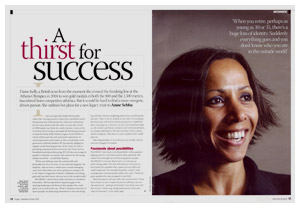
 Interviewing Dame Kelly Holmes feels rather like running around a track with a personal trainer. Exhausting but exhilarating.
Dame Kelly, a British icon from the moment she crossed the finishing line at the Athens Olympics in 2004 to win gold medals in both the 800 and the1500 metres, has retired from competitive athletics. But it would be hard to find a more energetic, driven person.
Her infectious enthusiasm for the many projects she has taken on since 2004 makes you think she could motivate a horse to fly. Currently she is trying to persuade the British Government to fund the Dame Kelly Holmes Legacy Trust (DKHLT), which will harness the rich and varied experiences of retired sportsmen and women so they can bring on a new generation of British athletes. British Telecom has already pledged its support as the founding partner for the Trust. As well as providing communications services to the Trust, such as broadband and teleconferencing, BT will also encourage its people to volunteer to act as coaches and mentors for the young athletes involved.
“When you dedicate your life, emotionally and physically, for 10 or 20 years, to one ultimate big goal,” she explains, “and you have a whole team around managing your time, then when you retire, perhaps as young as 30 or 35, there’s a huge loss of identity. Suddenly everything goes and you don’t know who you are in the outside world.”
The DKH LT, which she will chair, is a brilliant innovation. Dame Kelly has spotted an important gap in the sporting landscape and there are few people who could paint it in as well as she can.
“What I realised is that lots of sportspeople, by dedicating themselves to this one thing, lose all their chances of getting educational qualifications. They’ve never worked in any other environment. But that same self-driven and focused person could have been a manager or a director. So why not bring them back as role models and heroes, mentors or technical advisers, coaches and leaders? We don’t do that in this country and it’s a big loss. They have so many qualities they could pass on.”
Dame Kelly, the first National School Sport Champion, is passionate about the possibilities. Like all good ideas, it is so obvious you wonder why no one ever thought of it before.
“If you ask ‘where are they now’ about people who have won medals often no one knows. I know people who have really suffered a downfall after all that adulation and buzz suddenly disappears. They may make the odd appearance at schools and that’s great. But it’s a bit of stardust. Yes, the kids love it, but if we really want to make long term changes we need more than the occasional visit.
“We need to do data analysis for all these retired young people to find out their passions and how we can use them in the best way and match them up with their communities.”
The DKH LT also feeds in to her other passion; helping hard-to-reach kids achieve their potential in a variety of ways.
Holmes insists that although she will be using sports people, the DKH trust is not just about sport, or training up and coming talent. “For kids who lack any direction or focal point the qualities that a sports person offers are really important, for example discipline, respect, time management, communication skills and vision. These are great qualities for any youngster in any field.”
Then she pauses and says with real commitment: “If you have a hero, or just a respected person talking to you on the same level…perhaps admitting ‘I was there once and this is how I chose to go along that journey to become what I’ve become,’ it can really help.”
Holmes, 37, is the eldest of five children born in Kent to a white mother, Pamela Norman and a British West Indian father, Constantine Holmes, who was absent for much of her childhood. Even at primary school, her teachers spotted not only her athletic prowess but her absolute determination to win whatever she undertook. Although she trained from age12 onwards at 18 she joined the joined the British Army, where she served for nine years initially as an HGV driver before becoming a physical training instructor in 1991. She reached the level of sergeant when she realised, watching a former opponent at junior level running the 3,000 m at the Barcelona Olympics, that she could do just as well. She persuaded the Army to allow her time to train and, in spite of numerous injuries and emotional set backs, never lost her self-belief.
Even before her triumph at Athens, having won various bronze and silver medals, Holmes had made up her mind that she wanted to give something back.
“I wouldn’t want anyone to go through what I’ve been through,” she insists.
She proposed a mentoring project, now sponsored by Norwich Union, initially to take eight girls away to South Africa for a month to train. Now called ‘On Camp with Kelly,’ the project has grown to fifty girls, all middle distance runners aged 16-19, who have benefited enormously from all the experience Dame Kelly learned the hard way about the many pitfalls of sport.
She gives them basic information, nuggets that no one ever taught her, including
advice about diet and sleep, packing the right things in your hand luggage, sharing a dormitory with foreign athletes and thinking about having two pairs of trainers and phasing out the old pair slowly. “Not knowing this probably cost me my stress fracture,” she says. Now she is burning to pass on her knowledge in an attempt to protect and nurture other young talent.
One of Holmes’ favourite catch phrases is her determination to make a difference. She realises she can do this by being a mentor and educator which sports people need alongside, not instead of, a coach.
“80 percent of sporting success is believing in yourself and learning not to panic and waste energy if something goes wrong like lost baggage or a delayed flight.”
Looking at her website, * I counted at least nine charities she is involved with, not all in the sporting field , ranging from the Prince’s Trust to those helping sick and terminally ill children, helping to beat bullying or to understand and combat self harm. Clearly, she is busier now than ever and making a difference to a lot of kids.
“I’m self-driven. I always have been. I like giving back because I know how it feels, that buzz when you’ve achieved something, and I want other people to have that feeling of being proud that you’ve achieved something. I was just a girl who had a dream. I believe whatever the obstacles everyone has a skill and an ability to do something better in their life than they realise. Often it needs someone else to come along and say ‘have you thought about this or that.'”
Growing up on a Kent council estate with few other black children, Kelly faced plenty of obstacles herself. After she made her international debut in 1993 she was dogged by injury. But she has remarkable insight into her own psyche. “I have to have a challenge, a goal,” she admits. “That’s the person I am.”
The DKH LT is not simply the latest but possibly the most important challenge; she is taking on the business world, making speeches to politicians and CEOs of the sporting world as well as understanding budgets and business plans in order to secure Government funding.
She wants the Trust to be recognised in the sporting landscape as something that will complement what already exists in a positive way. “I’m really trying hard to persuade all the organisations out there at the moment how the new Trust will fit in and benefit everyone. Instead of being amateurish we must be professional. I really believe this is something we are not doing and could be doing and is really needed.”
When Dame Kelly Holmes decides to do something she has shown she knows how to get there in the end. The DKHLT could be one of the longest lasting legacies in Britain of the 2012 Olympics.
For more information visit: www.doublegold.co.uk
Anne Sebba’s latest book Jennie Churchill : Winston’s American Mother .