
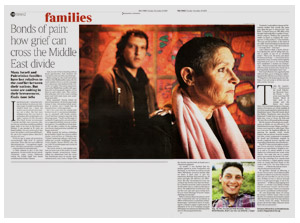
 “I was 10 years old. I remember visiting my mother in prison and feeling so angry. I couldn’t hold her and couldn’t touch her. I knew my mother was not a thief, not a criminal, not a killer. She had done nothing wrong. She was a hero among her people and among me because she was fighting for my rights,” explains Ali Abu Awwad, a Palestinian.
“From the start this was a
personal violation for me more than something political.”
“Later, both of us were in the prison in Hebron. When I was 15, I was arrested under an Israeli military law and sentenced to four years. My mother, Fatma, a well known PLO activist, was in the women’s prison there but I saw her only once.”
While he was in prison Ali received an extraordinarily high level of political education. “Every day there were different discussion groups – management, negotiation, education and security committees – organised by the other Palestinian prisoners the whole time.”
In 1994, released as part of the Oslo agreement, Ali was exactly the sort of well connected, angry young Palestinian radical the Israelis might have feared would resort to further violence in revenge for his and family’s treatment.
And yet I am chatting to him over a cup of coffee in London and he is telling me about his own wife and children. Now 37, he is travelling with an Israeli grandmother, Robi Damelin, 65, who has become one of his closest friends. Before seeing me, they had both had tea with the Chief Rabbi and their plans for the week include a visit to a church, a mosque and a discussion with students at London University. They are trying to show, even as the Middle East conflict still rages, that grief can bring people together, if you listen to each other’s pain. They believe that the politicians will never create a lasting peace until both sides know and understand each other.
What happened? Shortly before his release from prison Ali led a hunger strike lasting seventeen days demanding better conditions. It worked and taught him the strength of non-violent opposition. But a few years later he was seriously wounded by an Israeli settler shooting at him from his car window on the road from Jerusalem. He was rushed to hospital in Saudi Arabia and recovered but still has pieces of the bullet in his knee. While there he heard the devastating news that his adored older brother, 32 year old Yussef, had been shot and killed during an argument with Israeli soldiers. Yussef had been trying to stop kids from throwing stones.
“Yussef was the angel of our family. He gave up his own school studies to support our family when my mother was in prison. He even worked for an Israeli charity. He was like a mother to me, making sure I always had sandwiches and didn’t go hungry at school.”
What stopped Ali seeking retribution for his brother’s death was a phone call his mother received from an orthodox Jew, Yitzhak Frankenthal, asking to visit. Frankenthal had recently lost his own son, 19 year-old Arik, who had been kidnapped and murdered by Hamas activists. In response to this tragedy he established a forum for bereaved families who had lost loved ones in the conflict to work together towards reconciliation and was determined from the outset that Palestinians must be equally represented at every level. Even a cheque requires both an Israeli and a Palestinian signature.
Ali recalls: “I was absolutely shocked that my mother agreed to invite Frankenthal and his family to our home as well as several other Palestinian bereaved families that we knew. I don’t want to give the impression that that first meeting was all peace and light. We still have out differences. But after 30 minutes everyone was crying. It was the first time I had seen Israelis cry, the first time that I had encountered Israelis other than in uniform ordering me about. We realised then that the other side can feel your pain and can even help work for your future. Revenge? What for? It does not bring anyone back.”
It was Frankenthal who also contacted Robi after her son David, an officer in the reserves, was killed by a Palestinian sniper in 2002 telling her about the Parents Circle. David, 28, studying for a masters degree in the philosophy of education at Tel Aviv University, was part of the peace movement and did not want to serve in the occupied territories.
“Suddenly I realised a bereaved Palestinian mother feels exactly the same pain when she goes to sleep as I do. I closed down my PR office even though I had worked for a number of co-existence projects. Nothing else seemed to matter as much as stopping the consequences of this madness. I was emphatic: ‘You may not kill anybody in the name of my child.’ I started working for the Parents Circle 24 hours a day. I will talk to anyone – even the devil – if it helps.”
Recently it must have felt like that was what had happened as a letter Robi wrote to her son’s killer shortly after he was apprehended, offering forgiveness, has only just had a reply on the internet, years later. Ta’er Hamad, who positioned himself on a hill opposite a checkpoint and killed eight Israeli soldiers and two Israeli civilians, rejects reconciliation saying David Damelin was a murderer killed as a symbol of an occupying army.
Listening to Robi, a South African born idealist Jew, and Ali, a West Bank former revolutionary Muslim, telling their stories in public as part of an interfaith project* at St Ethelburga’s, I realise how important trust is. So much so that when Ali raises his arms saying this is how a pregnant Palestinian woman is treated at a checkpoint, Robi does not flinch. This is not, he insists, just about hummus and hugs – a line he must have repeated in many countries. But tonight he hugs Robi as he says it. Not because they have established a mother-son relationship – that is too simplistic they both insist. But because after five years he knows how much she is hurting merely uttering the name Ta’er. Robi insists that she will, urged on by her older son Eran, go on writing and explaining to him about David . “Perhaps this is the beginning of a new dialogue. I am not going to let this turn me into a victim,” she says.
Today the organisation – officially the Israeli Palestinian Bereaved Families Forum, known as the PCFF or Parents Circle Families Forum – comprises more than 500 families. Much of their work is in schools and the Forum runs more than 1,000 classroom dialogues ever year where a Palestinian and Israeli member of the Forum speak together to either Israeli or Palestinian classes. They tell Israelis about the Nakbar, Palestinians learn about the Holocaust. In some cases where Israelis are not allowed, only a Palestinian speaker will address Palestinians. But this is rare and usually there are speakers from both sides many of whom, like Robi and Ali, travel the world spreading the message.
But the logistics of meetings are complicated, as Israelis are not allowed to visit Palestinian towns and villages, and Palestinians need a permit to enter Israel. They can overcome the logistical difficulty by applying for permits, which mostly happen, but not always. It is sometimes extremely frustrating when a joint programme is prepared for Israeli and Palestinian students to spend a weekend seminar together, and some of the Palestinians are refused entry for no reason.
The PCFF does not just address moderates. Forum members, including Ali, have spoken to Al Aqusa Martyrs Brigade in Jenin as well as to Jewish settlers in Gaza (before the withdrawal) and Israeli army officers. This week they are in London partly sponsored by the Jewish Film Festival for the screening of an episode from Good Intentions, a popular drama series on Israeli television based on the work of the PCFF. The show follows two women – Amal, a Palestinian from Ramallah, and Tami an Israeli restaurant owner, who develop an intimate bond which defies the uncompromising opposition each faces from among their own friends and families.
Ali describes himself as following a dream without being a dreamer. He hates labels but when pressed is “an active human being with a Muslim background.”
“I don’t want to be naive and I know there must be a political solution to resolve the situation. But I am not sure that we can live in one state perhaps we have to divorce first and then if we get married again it will be by agreement its like a couple arguing over whether or not they have children before they decide to get married the first condition is to want peace. Peace is to empower the pain for a good future not for damage.”
Ali cares desperately about the future for his own children; Yussef , who is 8, and Rachel, 7. It is obvious who Yussef is named for. But Rachel, I ask? Why does she have a Jewish name? He smiles; “Why not? Whenever people ask me that I reply ‘why not’ and so far no one can answer me why not.”
*Organized by www.theforgivenessproject.com
Further information or to buy the Cartoons in
Conflict calendar go to www.FamiliesForum.co.uk or www.theparentscircle.org