
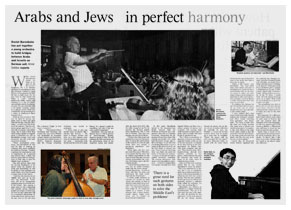
 Daniel Barenboim has put together a young orchestra to build bridges between Arabs and Israelis on German soil.
When Daniel Barenboim raised his baton at the start of the Brahms Symphony No 1 in Weimar yesterday he was doing his best, like President Clinton at Camp David, to bring peace in the Middle East a shade closer. For the past week he had coaxed into being a youth orchestra comprising Arabs, Israelis and Germans in a city of culture, contradictions and an incriminating past. He was rewarded with a ten-minute standing ovation for a sell-out concert which also included his own performance as a soloist in Beethoven’s Piano Concerto No 3.
When he first arrived in Weimar he faced 81 nervous students, some of whom had spent their one free day, Saturday, practising – so keen were they to impress the maestro. That this disparate group, aged from 11 to 25 and with an equally wide ability range, has in such a short time learnt to play together so magnificently is testament not only to Barenboim’s energy, vision and dynamism, but also to the healing powers of music.
“Music encompasses everything,” says Barenboim, 57, who had the idea of creating an orchestra that would symbolise the building of bridges. “Symbolic gestures are important as well as negotiations on a practical and rational basis. I think that there is a great need for such gestures on both sides to solve the Middle East’s problems.”
One such gesture came from the German headmaster of the school where the students are living and performing: he sent his pupils to other premises two weeks before term had finished to make room for the visitors. “I feel that the situation in the Middle East can’t go on like this,” says Barenboim. “Either there will be an arrangement leading to peace or a terrible war. If the former, then signing a peace treaty is only a beginning and contacts among ordinary people must begin, in which case the time we have spent here will be a wonderful introduction. If, on the other hand, there is a terrible war, then all this will seem like a fantastic Utopia. In both cases it is positive.”
The West-Eastern-Divan Workshop and Orchestra was created last year when Weimar was designated the European cultural capital and Barenboim, the music and artistic director of Berlin’s Deutsche Staatsoper and the Chicago Symphony Orchestra, was invited to participate.
“I didn’t want to give just another series of concerts. But I realised that Weimar – the home of Goethe, Schiller and Liszt, yet a few minutes away from the Buchenwald concentration camp – represented both the best and the worst of German history. So I agreed I would do something, but only if the two sides could be integrated.”
Barenboim, who was born in Buenos Aires in 1942 to parents of Jewish-Russian descent, moved to Israel in 1952. He will celebrate the 50th anniversary of his performance debut in the Argentine capital next month. After the death of his first wife, the cellist Jacqueline du Pre, he married the Russian pianist Elena Bashkirova, who is with him in Weimar. They have two teenage sons and live in Berlin.
“I believe that when Israel was created there was very little possibility of seeing the ramifications of the creation of a Jewish state where there was already a non-Jewish population,” says Barenboim. “What rights did they have and could they adjust? Therefore, if you accept that the Nazis had an indirect responsibility for the State of Israel then they also had indirect responsibility for what-ever misfortunes came to the Palestinian peoples.
“I started thinking about a positive way in which Germany could help the Jewish people – beyond reparations – to come to terms with their life today and understand the Arab world, especially the Palestinians.”
A mixed youth orchestra on German soil seemed an ideal vehicle, but initially he had no idea how many good young musicians there were in the Arab countries – nor what level of interest there might be. He would not commit to a concert; if they attracted only a dozen players, master classes might work better, and he wanted no governmental interference.
At this point Barenboim turned to his Jerusalem-born friend, Edward Said, the Professor of English and Com- parative Literature at Columbia University, recognising the importance of securing a major Palestinian personality who could lead discussion groups and reflect Arab ideas. It was Said who encouraged Barenboim to give a concert at Bir Zeit University, on the West Bank, in January last year. “I saw it was an interesting idea,” says Said, who spent two weeks in Weimar last summer, “so long as it did not turn into a conflict resolution workshop. The evening discussions were meant to be non-political, exploratory – in the first instance these were people who had never been together before and there was a certain amount of tension and suspicion. One evening some Arab musicians wanted to jam together and an Israeli, who tried to join in, got thrown out.
“But I tried to concentrate on questions of identity and culture, especially Goethe, as he was one of the first instances of someone in the West looking at the East, particularly the Islamic East, with great sympathy and passion.” The orchestra name, West-Eastern-Divan, derived from Goethe’s collection of love poems, which explored the need for tolerance, and which he began in his sixties when he started to learn Arabic.
Said, too ill this year to attend, admits that he was initially apprehensive about the project. “And I was surprised by its success. But it was so compelling and I was so impressed by the intensity of the young musicians in rehearsal and how that carried the day. They left what seemed to be their personalities behind and gradually became a collective entity called the orchestra. I’ve never seen anything like it.”
Barenboim, too, believes an orchestra is a unique vehicle for transformation. “Not one of us who came last year is the same. We were all enriched by that experience.” As he walks around the pit, his energy passing through the players like an electric current, he joshes with them all, especially his own son, Michael, a 14-year-old livewire violinist whose back he pushes up to make him sit straighter. “What’s the matter with my shirt, you don’t like the colour?” he teases Mohamed Saleh, an oboeist with the Cairo Opera Orchestra who says he has learnt more in two weeks here than in four years in Egypt.
“Music is like history,” says Barenboim. “You must know what comes before and after or simultaneously. Each note has a transforming effect on the next. I’m trying to make you learn what it means to be in constant relationship to other instruments.” And, of course, you know that he is really talking about how they relate to each other.
To reinforce this dialogue he has insisted that wherever possible an Arab and an Israeli should share not only a dormitory but a music stand. “I soon realised there were some Israelis and Arabs who felt nothing but animosity towards each other, mostly stemming from ignorance,” says Barenboim. “For many on both sides ‘the other’ was simply someone who could send a missile over into his own country. Yet suddenly they were sitting at the same music stand, trying to play the same notes with the same dynamic, the same quality of sound and attack, and the only way to do this was to do it together.” Carmel Raz, an 18-year-old Israeli violinist, explained how the workshop has changed attitudes. Last year she made friends with Christine, an Israeli Palestinian who had come to Weimar as an observer. When part of the Divan
Orchestra gave a concert in Bethlehem at the end of 1999, Carmel stayed with Christine’s family. “Before, if there was trouble on the TV news, I would think, ‘Oh well, they’re throwing stones at us again.’ Now, I call her up immediately to see if her family is all right.
“My grandfather was born in Berlin and we still have the key to his house. Christine’s family still has the key to their old house in Israel. In a way it’s the same tragedy.”
Ilya Isakovich, 23, a Russian-born Israeli violinist who, when he came came to Weimar last year was sceptical about the standards of the Arab string players, has now agreed to give violin lessons to Bashar, a Palestinian who will have to travel for two hours to meet his new teacher. Karim Said, a cousin of Edward and at 11 the youngest member of the workshop, put it succinctly: “If they’re nice I like them. If not I don’t. Whether they are Israeli or not doesn’t make any difference.”