
 A doctor has been working in Ethiopia for three decades to treat young girls for a condition that can leave them desolate and abandoned. Anne Sebba reports.
IMAGINE a 15-year-old girl, pregnant for the first time but unable to deliver the child vaginally. She will spend six days of agonising, obstructed labour, mostly squatting, in an isolated village hut with no hospital or clinic near by, and just a mother-in-law for a midwife. Eventually, the baby dies inside her and shrinks enough to be squeezed out.
But the sadness of the dead baby is only the start of her torture. What happens, if the girl does not die of sepsis, is that the pressure of the baby ruptures the tissues between the vagina and the bladder or rectum so that urine leaks out constantly and her clothes are soaked day and night.
These appalling birth injuries are called fistulae. Within ten days the girl will be incontinent. Reeking of urine and sometimes also faeces, she will probably be thrown out by her husband. She will become an untouchable, an outcast, with scant means of survival other than begging.
In developed societies a woman having a difficult labour will go directly to hospital to have a Caesarean section. In Ethiopia, the world’s poorest country, there is only one doctor per 36,000 of the population and many villages are three days’ walk. Unsurprisingly, 8,500 women a year in Ethiopia suffer fistulae – possibly a million throughout the world.
“If you had 8,000 men with incontinence of urine something would have been done for them,” insists Dr Catherine Hamlin, who founded the world-renowned Fistula Hospital in Addis Ababa with her late husband, Reg, in 1975. “But because they are women, and mostly provincial women, they are second-class citizens in this country. Their plight is so sad: a fistula is a preventable injury.”
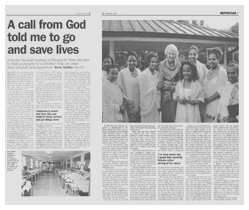
Hamlin, a grandmother of 81, is the least strident of women. Tall and upright, she still works as a surgeon and talks in a gentle but matter-of-fact way with lingering traces of her native Australian accent as she describes to me, during a brief visit to England, the tragic medical needs of these women to whom she and her late husband, Reg Hamlin, have devoted their lives.
She has recently co-authored a book, which details some of the most harrowing cases. It is also a compelling account of how ordinary people can make a difference.
“Catherine is not only sweet and kind. She can relate to Ethiopian women, and she gets things done,” says Professor Gordon Williams, a London urologist who goes, at his own expense, four or five times a year to the hospital, sometimes just for a weekend, to operate and to teach Ethiopians his skills. Williams clearly remembers his first visit 16 years ago as a British Council examiner “because it was the first time I had seen a holistic approach to such problems. This wasn’t just a fistula hospital. You saw a total change within days of the girls’ arrival. They started brushing their hair again, knowing they would be cured. They were given new clothes and after the operation were taken by a driver to the bus station. Nobody was ever turned away.”
Catherine Hamlin has always been a committed Christian. She was born into a prosperous family in Sydney. Several ancestors were missionaries and her mother ran a Sunday school. She believes that as a child she had a call from God telling her to “feed my lambs” which inspired her throughout medical school. Reg, a New Zealander, also came from missionary stock. He won a medical scholarship to study in Sydney.
She explains: “These girls cannot understand what is happening. They see it as a punishment, an affliction and don’t associate the condition with their long labour. They have no idea why they are suffering. Several commit suicide.”
One of the many appalling stories she tells is of a woman totally ostracised who had spent nine years never emerging from her darkened hut and surviving on food left once or twice a day. But there are other heart- warming stories of former patients who now work in the hospital. Mamitu, for example, arrived as a teenager with shocking injuries to her bladder, rectum and birth passage. She had no formal education but is now a competent fistula surgeon. Reg taught her.
In 1959 Reg and Catherine answered an advertisement in the BMA’s journal, The Lancet, to set up a school of midwifery in the Princess Tsehai Memorial Hospital in Addis Ababa. Abandoning their successful obstetric and gynaecological practice in Sydney, they accepted a three-year contract and, along with their son Richard, aged six, left for Ethiopia.
“It was all very primitive. There were goats on the plane wandering up the aisle. When we finally landed in an open field there was no one to meet us so we just set off with our bags but we walked in the wrong direction. I remember my husband said, ‘Never mind, Cath, I’ll take you back to Sydney’.”
But they found the hospital and were warmly welcomed. Almost immediately, they encountered their first fistula cases.
“We had read up on the problem, because we knew it occurred in developing countries, but we had never seen a case. The departing doctor, who had been performing a surgical procedure which gave some temporary relief but resulted in other long-term problems, warned us: ‘The fistula patents will break your heart but there is nothing you can do…'”
Reg and Catherine started treating a few of the more straightforward fistula cases. There was only one operating theatre in the hospital, which meant that only 30 or so operations were carried out in the first year.
She says: “As fast as we cured them, more turned up from the countryside. Word spread that something could be done.”
Before long, they were besieged by desperate girls who, having begged for months, possibly years, to fund their journey to the hospital, would then sleep wherever they could, in the grounds, the corridors or on stairs. One room, no bigger than a cupboard, was soon overflowing with bodies and a dreadful stench filled the building.
“Matron got upset and private patients complained,” Hamlin says. “Reg, summoned to the Health Ministry to account for this ‘new’ epidemic, showed them a slide of a mummy in a pyramid with a fistula. What was new was the way we were treating fistulae. In some cases we took a muscle from the leg to make a new urethra.
“Reg also explained that because public hostels would not accept these women, dormitories needed to be built in the hospital grounds, where the women could wait until we could operate on them.”
The Government agreed, and by their second year, the Hamlins were performing 300 fistula repair operations. By the end of the 1960s the Emperor, Haile Selassie, supported the idea of a dedicated hospital. This was crucial because the need for a specialist fistula hospital was now obvious to the Hamlins; Selassie allowed them to buy land, a rare possibility for foreigners. In 1975 the Addis Ababa Fistula Hospital opened, then the only one in the world. It is run entirely by charitable donations.
When Reg died in 1993, Catherine never doubted that she had to carry on: she took on extra responsibilities, such as fundraising lecture tours. Last year she spoke at the UN headquarters in New York and flew to Chicago to appear on Oprah Winfrey’s TV chat-show. Winfrey was so disturbed by Hamlin’s account that a few months later she visited Addis Ababa.
Catherine has been dubbed “the new Mother Teresa”, a comparison she does not like. “It’s ridiculous,” she says. ” I am not working for nothing. I get a salary. I have a lovely garden and a happy life, full of picnics and nice things with my family.”
But this has not come without a heavy emotional cost. Richard, the Hamlins’ only child, was eventually sent to boarding school in England. Such was their dedication to the hospital that they could not always be there when he needed them. Even during the most dangerous days of the civil war, they never abandoned the hospital for the relative safety of the British Embassy. Several friends were killed or imprisoned and Hamlin herself narrowly escaped a bullet. But the account of Richard’s eventual decision not to become a doctor makes for painful reading in the book. For months, Hamlin explained, Richard tried hard to continue to study medicine, wrestling with competing emotions, his heart telling him that he disliked medicine while loyalty to his parents kept him going. When he returned to Addis for a holiday, Hamlin understood how profoundly disturbed he was. But though she longed to keep him in Africa, his father had mapped out his son’s future and felt he should return to London to complete his medical studies. “Looking back,” she says, “I realise that we did not fully understand the crisis he was experiencing and, to our shame and selfishness, we failed Richard in his hour of greatest need.”
He is now an IT consultant, married, with four children. He and his family have just spent four months in Addis Ababa contemplating a possible role for him in ensuring the future of the hospital.
Inevitably, there have been criticisms. Says Hamlin: “I’ve been asked why waste your time repairing fistulae when you should be stopping early marriage, which causes it? Of course, we don’t agree with early marriage and we do lobby the Government. But it’s much more complicated than that. If we disturb the system of early marriage, what will happen is kidnap and rape. The early marriage is a form of protection to safeguard a girl’s virginity.” She understands, however, that the problem will be eradicated only when preventive measures such as better roads, more local doctors and clinical networks are set up. One scheme already under way is to establish five outreach clinics to provide pre-natal care for high-risk fistula repair mothers as well as post-operative care and education. A local person visits remote villages finding women who are often too frightened to come on their own. Traditional treatment for a fistula is to tie the woman’s legs together, but this produces contractures of her knees, hips and back and years of physiotherapy may be needed if the young woman is ever to walk again -or before she is straightened out for the necessary fistula surgery.
Regular visits from physiotherapists have been paid for by a girls’ school in England but each of the projected outreach units costs Pounds 64,000. Hamlin knows that if her work is to continue she needs an adequate endowment fund “so that we can live on the proceeds and stop begging ourselves”.
Gordon Williams is certain that Catherine Hamlin has a vision. “It includes empowering women and educating them,” he says. “The essential difference between her and Mother Teresa is that Mother Teresa’s patients may die happy but Catherine’s survive and go on to new and often happy lives.”
The Hospital by the River: A Story of Hope, Monarch Books, £7.99