
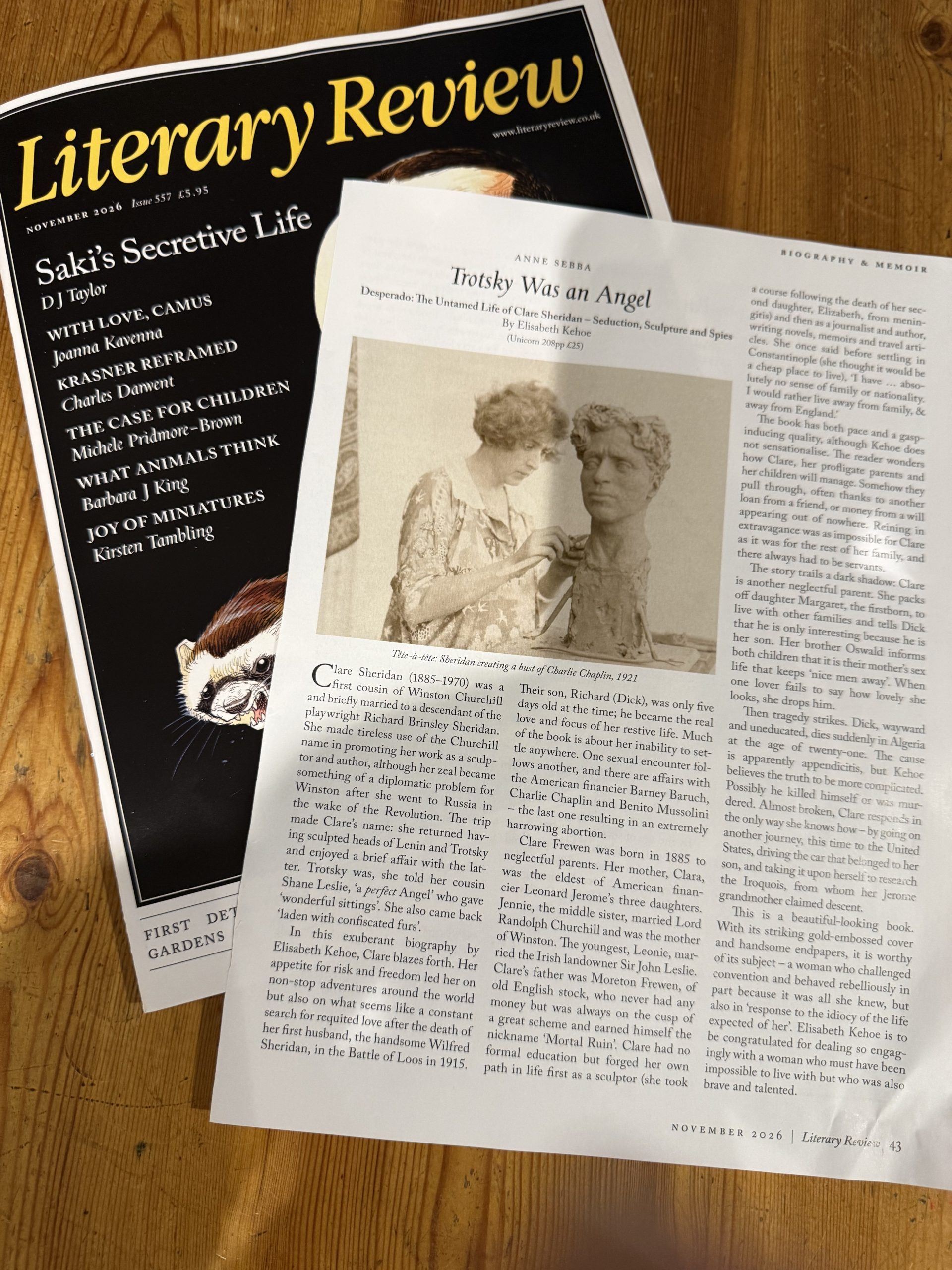
Clare Sheridan was a first cousin of Winston Churchill and briefly married to a descendant of the playwright Richard Brinsley Sheridan, both useful connections when publicity was required. The Churchill name was used tirelessly in promoting her work as a sculptor and author although it was also a double-edged sword which Winston had to manage carefully especially when his cousin went to Russia in the wake of the Bolshevik revolution and the shocking murder of the Tsar and his family. This was the trip that made Clare’s name as she returned having sculpted heads of Lenin and Trotsky, while also enjoying a brief affair with the latter whom she told her cousin Shane Leslie was ‘a perfect Angel’ who gave her ‘wonderful sittings’. She also returned laden with confiscated furs.
But in this exuberant biography by Elisabeth Kehoe, Clare blazes forth in her own right, as she should, and what a fireball of energy and talent she was. Her seemingly inexhaustible appetite for risk and freedom led her on non-stop adventures around the world but also on what seems like a constant search for requited love after the death of her first husband, the handsome Wilfred Sheridan, who was killed in the battle of Loos in 1915. She was pregnant at the time with their son, known as Dick, who became the real love and focus of her restive life. Much of the book is about her inability to settle anywhere as one sexual encounter follows another including affairs with the American financier Barney Baruch, Charlie Chaplin and Mussolini – the last one resulting in an extremely harrowing abortion acquired with danger and difficulty in 1922 new York.
Clare Frewen was born in 1885 to neglectful parents. Her mother was Clara, the eldest of the three American Jerome sisters – often referred to as ‘dollar princesses’ yet they had no dollars to speak of. Jennie, the middle sister, married to Lord Randolph Churchill, was the mother of Winston, and the youngest, Leonie, married the Irish landowner, Sir John Leslie. Her father was Moreton Frewen, a man descended from old English stock who never had any money but was always on the cusp pf a great scheme and therefore earned himself the nickname ‘Mortal Ruin’, not a funny joke if you were one of his children. In spite of a painful beginning thanks to a lack of formal education and the ethos of her day that girls did not need education, Clare was extraordinary even for the period in the way she forged her own path in life first as a sculptor (she took a course following the death of her first child) and then as a journalist and author writing novels, memoir and travel articles. She once said before settling in Constantinople which she thought would be a cheap place to live: “I have absolutely no sense of family or nationality. I would rather live away from family and away from England.”
The book has both pace and a gasp-inducing quality, which Kehoe grasps but sensibly does not need to embellish, as it derives from a feeling of how will Clare, her profligate parents and children manage? Can it get any worse? Yet somehow, they pull through (almost) thanks to another loan from a friend, shockingly spending the inheritance of children, or the Will of a grandfather appearing like a proverbial deus ex machina. Reigning in extravagance was as impossible for Clare as it was for the rest of her family and there always had to be servants
Yet the story trails a dark shadow as Clare is just as appalling a parent as her own rackety set were, shunting off daughter Margaret to live with other families telling Dick that he is only interesting because he is her son. Her brother Oswald warned both her children that it was their mother’s all too public sex life that kept nice men away. Never one to hold back she did not shirk from arguments when one lover failed to compliment her on how lovely she looked she was finished with him.
Just as the story of never-ending extravagance, dwindling funds and yet another lover beating a hasty retreat seems to be on an eternal doom loop, tragedy strikes. Clare’s 21-year-old son Dick, wayward, feckless and uneducated, dies suddenly in Algeria. The public version of events was that he had died of a delayed appendicitis, but Kehoe believes the truth is more complicated. Possibly he killed himself or else, behaving recklessly, was murdered. Clare was almost broken yet managed once more to respond in the old familiar way by going on another journey, this time to America, driving the car that had been her son’s, researching Native American tribes as the family believed that their Jerome grandmother had Iroquois blood. As she wrote to her aunt Leonie, always a mother figure to her, she was grateful for ‘those few unknown drops of Indian blood .’
This is a beautiful looking book which is a pleasure to hold. Its striking cover with embossed gold and handsome endpapers is worthy of its subject who constantly challenged convention and behaved rebelliously partly because it was all she knew but was also, Kehoe writes ‘an atavistic response to the idiocy of the life expected of her.’ Kehoe is to be congratulated for dealing so fairly with a woman who must have been impossible to live with but who was also beautiful, brave and talented and richly deserves to be remembered.
Anne Sebba’s latest book is The Women’s orchestra of Auschwitz A story of survival. Weidenfeld & Nicolson