
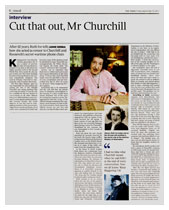
 Wartime Secrets Finally Revealed
Interview with Ruth Ive
‘Keeping Mum’ was what the wartime generation did. It was a matter of survival. But after sixty years Ruth Ive decided it was time to talk about her highly secretive work during World War Two. Now nearly 90, she has just written her first book detailing her demanding job monitoring Britain’s only wartime transatlantic telephone link used by Prime Minister Winston Churchill to communicate with US President Roosevelt.
Aged only 22, the then Miss Magnus was responsible for intercepting and immediately cutting the line if she thought Churchill was saying anything which could help the enemy. It was the only line available for the two leaders to communicate as all other Atlantic telephone cables had been deliberately destroyed to prevent German agents passing information between Europe and North America. It was also used by high ranking members of the Government, Armed Forces and Royal Family, all of whom were monitored by Ruth and her team. None of the speakers could be identified by name. Churchill was, unimaginatively, Mr White, Roosevelt – Mr Smith while ‘the Colonel’ referred to Mrs Churchill.
Secrecy was so important that Ruth had no written instructions and just had to grasp information as she went along.
“I had no idea what Churchill meant when he said KBO at the end of every conversation and just transcribed ‘Kay Bee O.’ Now of course we all know: ‘Keep Buggering On,'” Mrs Ive explained.
Everything had to be memorised and she was told that any private notes of telephone conversations or the keeping of a diary would mean instant dismissal. One of the spurs for writing her memoirs was her disappointment that few if any of the official histories mentioned this telephone, partly because of a lack of official documentation. Ruth herself signed the Official Secrets Act and was told after the war that the files which contained her transcriptions had been destroyed.
One publisher whom she approached with an outline of her work brushed her off saying: “I know women of your age (she was then in her late seventies) fantasise about having worked for Winston Churchill.” Humiliated by this response, she was more determined than ever to find records of what she did.
She has spent the last decade searching for accurate material for this book. She found a large archive at the German Historical Institute in London since, much as the British feared, the Germans had in fact learnt how to listen in to many of the 3,000 calls made from the transatlantic line. When I meet her in her North London house she immediately shows me a photocopy from the National Archives (Churchill’s private files there have been de classified only since 1995) of a note from Brendan Bracken, Minister of Information to Churchill in December, 1941, days before she took up her job, in which he discusses the Transatlantic Telephone Service. Below it is the PM’s response, agreeing to submit himself to the rules and adding that he believed “the Swiss and the Swedes should be placed under continuous check.”
Ruth Ive wanted to be an actress before the war. But, on her parent’s instructions, had taken a shorthand and typing course and in the summer of 1939 went to Cologne in Germany, in an attempt to rescue a Jewish family, when her father died suddenly. She came home, shelved her plans for the stage and, as war broke out, was soon recruited to the Postal and Telegraph Censorship, a department of the Ministry of Information. A year later, as an experienced stenographer, she was offered the job of censor.
“Calls had to be pre-booked and the connection was not made until we were ready with our headphones, pencils and paper,” recalls Mrs Ive. “I wrote the conversation of the London speaker on the left hand of the page and the Washington or Ottawa speaker on the right.”
She clearly remembers the occasion she had to disconnect Churchill twice in one call. “It was March, 1945 a Saturday, and a V2 bomb had just landed near London’s Smithfield market. There were about 150 dead and many more injured. He wanted to talk to Anthony Eden, then in Canada, and started giving him details of what had happened. I had to make a snap decision and remind him that this was a subject that could not be discussed. He grunted but was terribly upset. The problem was he had been disturbed from his nap.”
According to Ive, Lord Beaverbrook, who often went to Washington as the Prime Minister’s envoy, was the worst, “an absolute horror. He was so indiscreet and would give dates when a convoy was leaving.”
One of Churchill’s special friends, with whom he was most relaxed, was the American financier, Bernard Baruch. “They were just two old gentlemen having a chat about life at the end of the day when everyone else was in bed. Churchill had such energy and grasp of detail and was addicted to the phone.”
How did she manage never to discuss her work with friends? “They were such desperate times, we all accepted hardship. I don’t just mean rationing. Tragedy was never far away and everyone you worked with was suffering, knew someone who had been killed or was in danger.”
The hardest part, she says, was not allowing her mother to boast that her daughter worked for Churchill. By a strange coincidence, Ruth’s mother had been a guest at Churchill’s wedding in 1908 as her uncle, Dr Joseph Dullberg from Manchester, had been a friend and early Churchill supporter during his election campaign in North-West Manchester in January 1906. But Ruth never told Churchill about these long standing family links. “Looking back, I think I should have done but we had a completely professional relationship and I just felt I did not want to risk losing my job by changing that.”
After the war Ruth married and became Mrs Ive, housewife and mother of two sons, and never saw Churchill again. She took up journalism but suffered recurrent ill health, the result, she believes, of wartime deprivation and unhealthy working conditions. However her journalistic instinct came in useful when she decided to write her book. In spite of her 89 years she did all her own research and completed the book on a modern Apple Mac computer. But she tells me not to email her if I have any questions as she is about to change to a new machine, a laptop in future.
*Listening In To History by Ruth Ive will be published by Tempus in 2008
Anne Sebba is the author of Jennie Churchill : Winston’s American Mother published by John Murray September 2007.